Showing posts with label design. Show all posts

Monday, January 26, 2009

On decluttering

As I mentioned in my previous post, some of the key ideas I've been exposed to over the past few months have been to do with decluttering.

Bruce Sterling's Viridian philosophy has at it's root an understanding that material possessions, beyond the tools we use every day, are essentially a tedious distraction.

As Sterling says himself:

It may belong to you, but it does not belong with you. You weren't born with it. You won't be buried with it. It needs to be out of the space-time vicinity. You are not its archivist or quartermaster. Stop serving that unpaid role.

The bulk of the stuff around me right now consists of various kinds of data-storage. There is also a lot of junk.

There are also some tools.

Why don't I lose the junk?

Nassim Nicholas Taleb makes a similar point concerning information: we are exposed to all sorts of information on a daily basis. But only a vanishingly small fraction is of any use to us.

The human mind being what it is additional information clouds our judgement of mundane, day-to-day matters as well as distracting us from what is truly significant (whatever that might be).

And finally Getting Things Done from David Allen. This strikes me as the ultimate in decluttering: it is the removal of all the nagging jobs and chores that we hold in our minds all the time and the placing of them elsewhere for processing.

Friday, January 09, 2009

Living the good life elegantly

One of the ideas Nassim Nicholas Taleb comes back to again and again, both in The Black Swan and Fooled by Randomness is that you can and should live elegantly.

Living elegantly means being stoical about loss and disaster, and not working too hard or becoming overly stressed when things don’t go your way.

It also means avoiding “noise.” In this context noise is the constant humdrum flow of news and factoids that we all expose ourselves to in this information-saturated age. Reading the paper every morning doesn’t make you any more informed than someone who spends their time reading philosophy and history textbooks.

Taleb argues that the older something is the more likely it is to be of value: things that aren’t valuable tend not to be preserved or sustained in culture. This leads to an interesting comment on religion: whyever people believe in god is beside the point, millions of people do and have believed in God for thousands of years so there must be some psychological or cultural value to it. I’m inclined to agree with this, but not with the general point that “because we’ve always done it” is a good argument in favour of anything.

My objection is to the imposition of religious cultural values on those who do not believe: particularly the recent complaint to the ASA that the atheist bus is "offensive."

Stephen Green, national director of Christian Voice, sez:

"There is plenty of evidence for God, from people's personal experience, to the complexity, interdependence, beauty and design of the natural world.

"But there is scant evidence on the other side, so I think the advertisers are really going to struggle to show their claim is not an exaggeration or inaccurate, as the ASA code puts it."

Taleb would of course point out that you can't prove a negative ("God does not exist") and I would point out that the atheist bus does not claim to: "There is probably no God."

This statement is induced partly from lack of any indication of the existence of God so far (based on repeatable experiment, rather than subjective experience) and deduced from the internal inconsistency of most conceptions of God.

In The Black Swan Taleb presents a strong finding from cognitive psychology called the information bias that shows that being exposed to information more frequently does not necessarily improve your ability to make decisions.

Taleb also argues that being presented with a constant barrage of negative news is also bad for you from the point of view of happiness.

I’d like to draw a link between what Taleb says and the ideas of the Viridian design philosophy. In Bruce Sterling’s last note he says that people should minimise the amount of badly-designed clutter in their lives so that they might be happier. In the same way Taleb is advocating a reduction in information clutter, and concentrating on quality rather than quantity of data.

Thursday, March 27, 2008

On Steampunk Design

One of my favourite SR subgenres is that of "steampunk." I love Neal Stephenson's The Diamond Age and Stephen Baxter's The Time Ships.

Recently there have been a number of steampunk style casemods. These are great.

Part of the idea of steampunk is a celebration of the mechanisms within the machine itself.

There is also romance. The "style" of Steampunk, as exemplified by Alan Moore's depiction of The Nautilus in his The League of Extraordinary Gentlemen series.


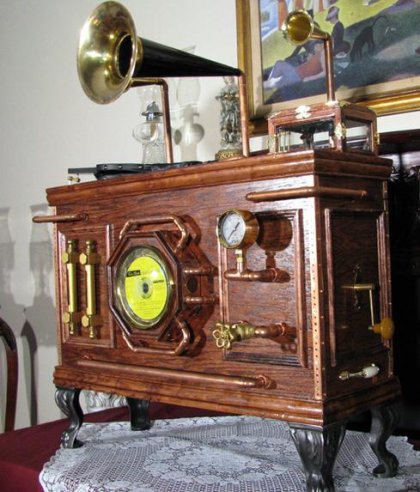
This "Bi-Orbital Spectral Audiometer" from Professor Emilio Zanturas is an example of a Steampunk style machine where the romance and style is more dominant than the fundamental mechanisms, which are hidden from view.


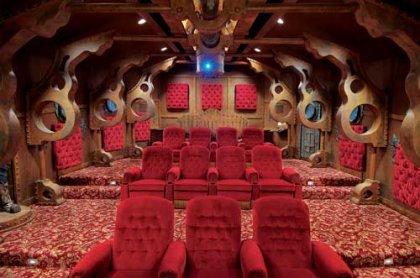
Here is another rather lovely Nautilus-inspired movie theatre from the designers of Tokyo Disneyland:


Combining this celebration of the mechanism with Victorian-era materials like brass, riveting, mahogany panelling, and a bespoke finish has lead to some amazing creations, all lovingly catalogued by the superlative Boing Boing.

Monday, March 10, 2008

Saul Bass

A while ago I commented on a trend in the design of movie and TV programme credits.

I noticed this style again in the opening credits of the sublime Mad Men.


A casual reference in The Independent informed me that this style was pioneered by someone called Saul Bass.


This sequence is inspired. Saul Bass is truly the Duke Ellington of graphic design.

This style must be retro at the moment.

Thursday, January 24, 2008

Stylistic Zeitgeist

It's interesting how particular styles crop up at particular times. There's a very good discussion of trends in logo design here. I also think there are some similarities between the opening credits of The Hustle and the most recent James Bond movie Casino Royale. This "paper cutout" style is also used in the closing credits of The Incredibles:


Friday, January 04, 2008

Design and Writing

I disagree with nearly everything Jeremy Clarkson says, but I agree with him that there is some indefinable essence that certain items are imbued with. Good design.

Good design transcends the value it gives by way of looks and usability and becomes a joy - something to treasure and value simply because it exists. Human ingenuity overcoming the mindless perversity of the universe and converting matter into something that does something well.

Things like the iPhone, and the Nokia 6310i.

Similarly some people write so well that what they write is good simply because of the way the words are arranged and which words are used. Stephen Fry and Terry Pratchett spring to mind. (incidentally I've never been more affected by the news that someone I don't know was ill than when I read that Mr Pratchett had Alzheimer's - the content of his books speaks of a very pleasant and very wise person, it is very sad that he will be robbed of something he and so many other people enjoy so much).

Good design is to be celebrated as much as good writing. It doesn't provoke wonder so much as joy that we can make this difference and do this thing so well.

Friday, December 28, 2007

Watch this Space...

At some time in the future I'll be writing a review of The Meaning of the 21st Century by James Martin.

In it he mentions "the tragedy of the commons" and how companies should factor in the cost to society and cost to the environment of their activities, as well as more familiar expenditures.

These ideas are similar to those explored by Genichi Taguchi in the eponymous Taguchi method of industrial design.

Just thinking aloud. Read and prosper.

Slightly later: LARRY NIVEN'S WRITTEN A NEW KNOWN SPACE BOOK! Thanks.

Monday, December 24, 2007

Technology

I was in the Manchester Museum recently (it is rather good), and I saw a rather splendid display of bows and arrows. These were in many different styles and from many different cultures. There were little interactive displays that told you how the bows were made. An awful lot of effort and craft goes into what I had always assumed was a simple piece of wood.

Thinking about this as I struggled to operate my rapidly aging Sony Ericsson K750i it occurred to me that nowadays that level of development is rarely reached. Innovation and evolution happen so quickly that there is no point in refining a particular device. Hence mobile phones and mp3 players are rather unpleasant and tacky. Good design does crop up occasionally but the general rate of development is such that avenues of design are left unexplored and concepts are left incomplete.

Putting aside speculative discussion of a spike or singularity in the near future I sometimes wonder what “technology” and devices will really be like in, say, a thousand years time. What will human beings look like and how will they move around? In what manner will they reach orbit? Will they even bother?

In the realm of the state change seems constant and always disruptive. The pointless and dangerous desire to collate and store information is partly simply due to the technology being available to do it. This leads to accidents.

I feel privileged to live in this time of change but I do sometimes wonder if humanity will ever achieve an equilibrium with its environment. 99% of human history consists of people living in hunter-gatherer style societies. The current "singularity" we're living through will presumably result in either out destruction or in some new equilibrium. I wonder what it will look like.