Showing posts with label review. Show all posts

Monday, June 22, 2009

A History of Economics


I forgot to mention I read this book a few weeks ago. Galbraith is an excellent and entertaining writer.

An underlying theme is Galbraith's emphasis on how the economic ideology of different historical periods seems to flatter those who hold power. Hence you have physiocrats in France during the 18th century, mercantilists during the 17th century, and neoliberalism during much of the 20th century, with a dash of Keynesianism for those who like that sort of thing.

I was reminded of this book whilst reading this lengthy thread at Crooked Timber in which Daniel "dsquared" Davis argues that economics should really be split into two disciplines: industrial cybernetics and political economy, with one being based on the development of practical applications of empirical research (like engineering) and the other being based on a discussion of the ethics, morality, and political consequences of different policies (basically a branch of political philosophy).

IIRC Galbraith endorsed this point: the idea that you can separate ideology from reality in political discussions is naive in the extreme (as Daniel argues here). Also Galbraith coined the term "the conventional wisdom" to describe beliefs that are widely assumed to be true for the sake of ideological convenience (think EMH, rational agents, drugs are evil etc)

I was going to write up a lot of quotations but frankly I can't be bothered: I advise you to buy and read a copy of this excellent history of this peculiar science.

[image from here]

Monday, June 08, 2009

House of Suns: definitely not a review


Just finished this 'ere book by Al Reynolds.

Thoughts:

1) An alright 500 page book with a good 250 page book struggling to get out.

2) There is a lot of boring, pompous, non-political politics goes on in "the Line". I feel the concept of someone creating thousands of clones of themselves and sending them out to explore the galaxy is good, but Reynolds kind of let it go without thinking through how it would operate IRL.

3) I don't know if it's a style thing (Stephen Baxter does it as well) but none of the characters talk as people talk. Ken MacLeod is much better at this sort of thing.

4) The most interesting characters (the Doctor and the Spirit of the Wind) don't get nearly enough of the airtime that is instead given over to the unconvincing political pomposity.

That said I really enjoyed this book. It's not as good as Century Rain or Pushing Ice, but is considerably better than Prefect.

Sunday, May 17, 2009

The Accidental Pornographer: not actually a review


A brief summary of lessons learned from The Accidental Pornographer:
  1. Do not fall in love with the concept before you have scoped out opportunities for expansion. Griffiths discovers that the potential market for his product is smaller than he assumed only after he is well into it.
  2. Do not get hypnotised by the prestige of others. Griffiths uses M&C Saatchi for marketing, despite their high-cost.
  3. In planning your cash-flow always bear in mind the worst case scenario.
I've actually met the author, Gavin Griffiths, though I didn't know who he was at the time. I was working in our local branch of WH Smith and he came in to ask if we had this book in stock, as he had written it and wanted to know if it had hit the shelves yet.

My fleeting impression of him was of an earnest and unobjectionable individual. This is reinforced by his book and his blog.

The book is recommended for much the same reasons as Paul Carr's book Bringing Nothing to the Party. It is story of business failure, though neither Carr or Griffiths fail completely.

And you learn more from failure than you learn from success. Karl Popper teaches us this.

Wednesday, May 06, 2009

The Night Sessions: a few thoughts


I read this book over the weekend. A few thoughts:

1) Very good treatment of religion. Harsh criticism of faith-based brutality mediated by a genuine understanding of the nature of faith. There is a part near the end that captures the essence of what losing a strong religious faith is like perfectly:

He knew exactly what he now believed, because it was exactly what he had rejected until now. He'd stepped out of shattered armour not naked and shivering, but fully clothed. It was as if his new world-view had all along been inside the armour and being kept in, rather than outside and being kept out.


2) Very plausible treatment of sentient robots. Probably the best treatment I've seen in a while. The key point that MacLeod makes is that yer typical sentient robot is likely to have a superior theory of mind to yer typical sentient animal. Therefore robots are likely to be kinder, gentler, and more empathetic than humans.

The book is strongly recommended, being well-written, and the characters spend a lot of time talking in pubs. There is little and life that could not be improved by spending more time talking in pubs. Certainly Stephen Baxter's work would gain a lot.

[pic borrowed from here]

Friday, March 27, 2009

The End of Politics: a review

I stumbled across Chris Dillow's blog (entitled Stumbling and Mumbling) after reading repeated references to managerialism in The Yorkshire Ranter and DSquared Digest.

A brief read of Dillow's blog suggests he is clearly too clever by half and, which is more, he knows that intelligence is irrelevant if you don't pay attention to empirical observations, or further are incapable of making accurate empirical observations.

Which leads into The End of Politics - Dillow's book.

Dillow's thesis is that, contrary to the standard caricature of being "all spin and no substance", New Labour does have a distinctive ideology.

This ideology holds that it should be possible to combine equality and economic efficiency, and that there is no trade-off between these two goals. Any problems that emerge can be dealt with through effective management.

Dillow calls this ideology managerialism. Managerialists believe that the job of government is to behave like managers of a company. Managerialists do not perceive the inherent trade-offs and conflicts of interest that are endemic to politics, and are indeed the reason for the existence of politics. Managerialists believe conflicts of interest can be resolved with good leadership and appeals to a well-defined national interest.

Managerialism is distinct from the scientific management of Frederick Winslow Taylor, which was concerned with organising resources effectively. Rather managerialism is the belief that there exists an abstract concept of "good management" that can be applied to every situation, regardless of the underlying organisational substrate.

Managerialists are obsessed with the idea that the world is new and constantly changing, thus simultaneously justifying managerialist action and ensuring that it is impossible to objectively test the efficacy of a managerialist policy because by the time it is implemented things will have changed.

Dillow also draws a link between Old and New Labour, describing how they are defined by their desire to achieve equality and economics efficiency simultaneously.

Dillow argues that there are trade-offs in politics that can't be managed away.

Further he argues that notions of "economic efficiency" or "equality" or even "rationality" are ambiguous and incoherent in and of themselves. He cites Newcomb's Problem to identify areas where traditional conceptions of rationality are limited.

Dillow shows that the arguments that globalisation have changed everything are false, and that concern over globalised capital and labour is as old as Adam Smith.

Instead, globalisation is used to justify New Labour's managerialist schemes.

Globalisation isn't necessarily irreversible, as the existence or non-existence of tariffs or immigration controls are at the whim of politicians.

Dillow shows that the evidence as to whether the national minimum wage destroys jobs is inconclusive, but taken as a whole, the research generally seems to indicate that the national minimum wage does destroy jobs but this is difficult to detect in aggregate economic data.

The attempts by the Beveridge-report inspired postwar settlement to achieve full employment lead to worker militancy and increased inflation, as workers campaigned successfully for higher and higher price rises in response to increased inflationary pressures that were in fact being caused by inflationary pay rises.

Dillow's arguments are a recurrent theme in what I've been reading. The Black Swan by Nassim Nicholas Taleb, The Origin of Wealth by Eric Beinhocker and now The End of Politics all have in common an empirically-supported belief that the powers of human rationality are more limited than we tend to assume. That centrally-planned projects often fail and that extensive government oversight of the economy is generally a bad thing.

So if the capacity of political leaders to manage things is inherently limited in all sorts of ways what is to be done?

The title The End of Politics is appropriate: Dillow pours flammable liquid over all the most cherished ideals of all politicians and sets everything alight.

Given the robust and thoroughly empirical nature of this book I am entirely persuaded by Dillow's arguments that most political projects are stillborn. There is never enough information for politicians to make good decisions, even if they were capable of doing so, or even had a clear idea about what qualifies as a "good" decision.

As an alternative to top-down managerialist politics Dillow argues in favour of the open society: that decision making should be as democratic as possible, simply because no centralised authority can possess all the necessary information to make good decisions.

Dillow believes hospitals should be run by doctors and nurses, and schools run by teachers, because no centralised manager in Whitehall can possibly predict "the facts on the ground."

He also suggests the intriguing idea of a citizens basic income as a way of partially solving the problem of welfare vs. working tax credits. It's an interesting idea, and one that appeals to the dilettante in me.

The basic lesson of The End of Politics is that in the complex world in which we live political and business leaders need to be more humble in the face of the inherent limitations of centrally directed institutions.

The best way to get anything done is to create the circumstances by which effective solutions can be evolved from the interactions and daily business of all the millions of people and machines in the world.

Nowadays, as professions become more and more specialised, it is important to hand control back to the professionals. Just as David Allen's Getting Things Done system was defined by Wired magazine as "Taylorism for the modern knowledge worker."

Just as the study of productivity has shifted emphasis from centrally-directed institutions to professional individuals Dillow argues that the response to increasing complexity in the world is to decentralise politics and business.

Both The End of Politics and The Origin of Wealth convey the message that economists and policy makers need to be more humble about the extent to which the economy can be controlled and that the best laid plans gang aft aglay.

Dillow advocates an open society and more genuinely democratic debate in which heterodox views and those who stand to lose out from policies are given a fair hearing. Political debate is likely to be fairer if things are done in the open.

My response to this book was initially fatalistic: if the world is so complex that we can never hope to control it, why bother attempting anything?

Dillow's answer is that government has a role in creating the circumstances in which innovation can take place. But it is not the role of government to attempt to change people or manipulate the economy, because it is incapable of doing so effectively.

In a broader context it is clear that our conception of human nature is changing and altering. We are coming to realise that we are not wholly rational, and even that rationalism itself is a canard.

Dillow has an excellent blog: Stumbling and Mumbling.

Wednesday, March 25, 2009

Against a Dark Background: not a review

I've finished reading Iain M. Banks' Against a Dark Background. Here are a few thoughts, bullet pointed, as this isn't a review:
  • This is a wonderfully indulgent piece of science fiction. The scope of imagination is huge and the cinematic expanse of Banks' imagination lends a sense of wonder to the story.
  • This is a profoundly humanist novel. The notion that people are truly alone and this life is all is explored through a variety of mechanisms and tropes. The Solipsists insistence that they are alone in their own universe, the finality of death and the transient nature of being are persistent themes. Also the nature of the System in which it the story is set.
  • This is a dark novel. Lots of death and failure and despair and general unpleasantness.
  • That being said Banks doesn't Pull the Nasty in the same way as he has done in The Algebraist and Consider Phlebas.
Well worth a read.

Wednesday, March 04, 2009

Thoughts on Feersum Endjinn and writing

This book has an immense span of imagination. Banks has an ability to create ideas that are just over the boundary of the absurd and yet implements them so that they seem almost homely and reasonable.

There is, in my limited experience of writing, a sort of mental crash-barrier between the familiar and comfortable and the strange and disturbing.

Great SF writers possess a kind of intellectual bravery in vaulting the barrier and hauling the strange into the familiar.

When writing I will pursue an idea as far as I can but there is always a part of me too willing to reject a plot or character or situation as too ridiculous for further exploration.

Feersum Endjinn starts superbly: with typical Banksian whimsy gradually revealing an immense canvas that (had I ever thought it) I would have immediately rejected.

There is a tendency towards dues ex machina in the plot: and the Bad Guys aren't as unpleasant as most Banks villains. However the story is compelling enough and the Good Guys interesting enough to follow through.

An excellent read.

Tuesday, February 24, 2009

On The Origin of Wealth

After a brief hiatus I have started reading this book again. Everything Taleb has written, sans the epistemic philosophy and general snark, can be seen as a subset of this book.

As I read Beinhocker is discussing how the observation that businesses evolve in the marketplace can be applied to practical strategy. He makes the point that for the most part conventional strategy and long-term planning is futile in the face of the complex non-linearities of the marketplace.

Beinhocker grounds his descriptions of economic activity in modern physics itself, rather than attempting to ape physics as many early economists (like Jevons and Walras) did.

Beinhocker defines wealth as useful order. And order is information, and useful information is knowledge. So knowledge is wealth.

Beinhocker says that value is created by:

• Irreversible actions
• Local reductions of entropy and
• Fitness

Fitness is determined by an evolutionary process, the free market, which can be thought of as a knowledge-generating machine.

Beinhocker advocates ideas similar to Alex Harrowell of the Yorkshire Ranter (who I suspect is familiar with the book), stating that we need to build institutions that evolve more effectively.

This sentiment runs counter to many traditional conceptions of Big Man, top down, authoritarianism. Politicians are praised for ignoring evidence and not adapting to circumstances.

The scientific method and free markets work so well because they lead to the creation of a large number of ideas and then subject each idea to testing, selecting the most successful ones, replicating and recombining these successful ideas, then repeating the whole process continuously.

The outcome is a an increase in knowledge, and hence wealth.

Friday, January 02, 2009

What I'm reading now


  • M150 Data, Computing and Information: Unit 5 Storing, getting and sending your data, OU.

  • T173 Block 3 Patents: The engineer as innovator, OU.

  • The Quark and the Jaguar: Adventures in the Simple and the Complex by Murray Gell-Mann.

  • Sams Teach Yourself Java 6 in 21 Days by Rogers Cadenhead and Laura Lemay.

  • Economics for Dummies by Sean Masaki.

  • Four Laws That Drive the Universe by Peter Atkins.


I recently (and finally) finished reading Arthur Koestler’s The Sleepwalkers. It was referenced in The Black Swan by Nassim Nicholas Taleb.

Taleb said that Koestler highlighted how the idea that science has progressed in a straightforward fashion is wrong. Science has evolved through a series of sudden breakthroughs, and with much time wasted in intellectual dead-ends.

Taleb describes the most valuable property of the scientific method and the free market as “stochastic tinkering.” Having lots of people messing around with different ideas and business models increases your exposure to potential breakthroughs.

The idea that history is a series of clear and well defined developments inevitably leading to some outcome is a canard. History is a random and chaotic process.

Science and the free market are also random and chaotic. However it is precisely because of this randomness that science and the free market are so powerful.

Because the free market encourages new ideas and methods and allows successful ideas to achieve success at the expense of less successful ideas the ultimate outcome is a system that maximises the potential for good ideas to achieve widespread adoption.

Similarly with science. Good ideas succeed at the expense of bad ones. However in the scientific method the ideas are judged on the basis of the successful predictions they make, or the fact that they have yet to be disproved by experiment.

In the free market good ideas are judged on the basis of how profitable they are (theoretically).

Gell-Mann touches on many of the same ideas as Taleb, particularly regarding complexity and what Gell-Mann refers to as “complex adaptive systems.”

Monday, December 15, 2008

Thoughts on "The Black Swan"

Having read "The Black Swan" by Nassim Nicholas Taleb (his website is here) I have come to a few conclusions:

  1. I spend too much time reading newspapers and on trivial and timewasting exercising (writing this blog post does not qualify as it counts as practice in writing and helps me organise my thoughts).
  2. Much of what I believe about the world isn't based on any kind of objective reality, but rather a collection of superstitions, cognitive biases[link], and predjudices.
  3. In certain non-empirical fields there is little value in deferring to experts if your intention is to accomplish something (like building a bridge, or making money).
  4. The value in the "free market" has less to do with competition and more to do with the resultant levels of "stochastic tinkering" that have the potential to lead to hugely influential but unpredicted developments.

The Book Itself

Taleb is arrogant, irreverent and amusing - all qualities I value in anyone. He writes engagingly, occasionally dipping into anecdote (for illustrative purposes, not necessarily to support his argument).

The Black Swan

A Black Swan is an unpredicted event that has a huge impact. Human beings tend to ignore Black Swan events when making decisions about the future, despite the fact that Black Swans tend to have an overwhelming effect in history, science, business, finance, and individual lives.

Black Swan events are outliers, they have an extreme impact, and third human nature has the tendency to attempt to "explain" the Black Swan after the fact, making it seem predictable and obvious.

Extremistan and Mediocristan

Taleb defines two areas of human experience: in Mediocristan things tend to behave in a fairly orderly and predictable manner. The distributions of height in a large population, for example, remain relatively close to a normal Gaussian bell curve even if you were to add the world's tallest man to the population - because he is not 3 kilometres tall he does not effect the overall distribution.

In Extremistan, on the other hand, outliers have a disproportionately large effect. The distributions of personal net worth in a large population, for example, will be completely thrown out of whack if you add Bill Gates to the population.

Power Laws and Guassian Bell Curves

In Extremistan, power laws (Pareto's Principle, Zipf's Law) and fractal relationships are the norm. In Mediocristan Guassian bell curves are the norm.

Taleb believes the bell curve is misused in it's application in investing (I wasn't aware the bell curve was used extensively in finance).

Scalable and Non-Scalable Professions

Inequality tends to follow a power law. The richest 1% own 50% of all assets, whereas the poorest 10% own substantially less than 10% of all assets.

With regard to income some professions lend themselves to black swans and power laws, and others don't. Medical doctors and priests will tend to earn roughly a certain amount, which will fall somewhere on the bell curve of income for that particular profession.

Writers, venture capitalists, entrepreneurs, and scientists, on the other hand, all occupy extremistan, or black swan territory. Some writers (like J.K. Rowling or Terry Pratchet) earn collossal amounts of money per hour worked whereas the vast majority will struggle to earn anything.

Empiricism and the Problem of Induction

How do we know that what happens in the past will continue to happen in the future? Taleb likes empirical philosophers like Francis Bacon and Karl Popper, and Sextus the Empirical. In trying to find knowledge about the world it is better to prove conclusively that something doesn't work than that it does - in fact you can't prove that something always works.

Knowledge, therefore, emerges from negatives. Disproving something adds to knowledge.

Platonism and Theories

Taleb rails against creating a theory and then selecting evidence to fit the theory. He dislikes the application of game theory to economics, and portfolio theory to investment. He describes the mistake of focusing on elegant, tractable mathematics at the expense of empirical knowledge as platonicity, and any knowledge divined from such abstract mathematical theorising is "nerd knowledge."

Cognitive Bias and the Narrative Fallacy

Correlation does not equal causation. Post hoc ergo propter hoc.

Terry Pratchett and Taleb

Pratchett comments extensively on the human desire to create stories (the Discworld is a world that runs on narrative, rather than physical laws) and on the fact that million-to-one chances occure nine times out of ten.

Also Pratchett's uber-politician Lord Vetinari is the embodiment of the knowledge that in an unpredictable world what people really, really want is for tomorrow to be pretty much the same as today.

Arthur Koestler and Taleb

Skimming through The Sleepwalkers by Arthur Koestler (which I have read) I can see many parallels between Taleb's dislike of platonism and Koestler's similar criticism of excessive theorising in physics.

Taleb refers to Koestler's book in The Black Swan in the context of the inadvertant nature of much scientific discovery.

Koestler was also intensely critical of the dogmatic nature of theoretical physics (as he perceived it). Koestler's problem was that, unlike classical physics, quantum electrodynamics involved fields and quanta that could be one or the other or something else, depending on your perspective. I personally think the problem is more to do with the fact that QED is counter-intuitive. We humans have evolved in a quasi-classical environment and just aren't set up for thinking in terms of the quantum environment of the very small.

Hayek and Stochastic Tinkering

Taleb believes the value in free markets lies in their ability to generate new idea in a process of stochastic tinkering. This apparently is what Hayek thought.

Taleb is also a fan of Francis Bacon and Karl Popper. Does not like Platonism - mistaking the map for the territory and overextending the use of models.

Whither singularity?

Both Kurzweil and Taleb are obsessed with the fact that humans tend to have an "intuitive-linear perspective."

Taleb doesn't comment on the singularity directly. He does refer to the importance of power laws and such.

Conclusions

There is a lot of food for thought in this book, and I intend to read a lot more about the various topics that Taleb raises.

As ever at this stage in my education any new knowledge raises more questions and than it answers.

However as Taleb's central point is that the world is in many ways fundamentally unknowable and unpredictable perhaps this is a good thing.

The objective of learning is not simply to know a load of facts, but rather to become comfortable with the limits of your understanding. To transform unknown unknowns into known unknowns and to cope as best you can with those things that remain unknown unknowns.

Sunday, September 28, 2008

Comment on "The Sleepwalkers" by Arthur Koestler

The Sleepwalkers by Arthur Koestler, is a history of the study of the cosmos, starting with the ancient Babylonians and ending with a discussion of Newton, via Aristotle, Plato, Copernicus, Kepler, Galileo.

Koestler seeks to demolish the assumption that the history of this particular subset of science is a Whiggish story of Progress towards a Theory of Everything. Rather it is a story of various people blundering around and gradually and haphazardly building a picture of the universe.

These philosophers and scientists "sleepwalk" towards understanding.

Enjoyable and iconoclastic, well written but with some flaws.

Some spiritualist stuff, which comes off sounding a little odd against the otherwise respectably skeptical tone.

Claims that electromagnetism and gravity are "verbal fetishes ... disguising the fact that they are metaphysical concepts dressed in the mathematical language of physics."

Well that's an interesting perspective. I wish I knew if Koestler was speaking from a view of ignorance or understanding as regards the mathematical underpinnings of gravitational theory.

It is unfair to say gravity is a metaphysical construct. It is a theory that currently suits all available evidence very well. We believe in it because the evidence suggests it exists.

However Koestler is right to reinforce how peculiar the idea of "action at a distance" (spooky or otherwise) really is. Descartes was having none of it. Newton presented his theory of gravity but said:

"gravity must be caused by an agent acting constantly according to certain laws; but whether this agent be material or immaterial, I have left to the consideration of my readers"

Dismissive of Einstein (p 504, Chapter 3 The Newtonian Synthesis 1. 'Tis all in Pieces):

"Einstein's correction to Newton's formula of gravity is so small that for the time being it only concerns the specialist. The two most important branches of modern physics , relativity and quantum mechanics, have not so far been integrated into a new universal synthesis; and the cosmological implications of Einstein's theory are still fluid and controversial."

I think Koestler rather misses the point here: as I understand it Newton was wrong to assume space is "flat" and Einstein demonstrates that space is not flat. Newton's theories are a good approximation of what goes on in the universe, and for most purposes do well enough, but Einstein is closer to being correct than Newton.

The book was published in 1959: I think Einstein's theories were bedded down by then.

All in all, an excellent read, drawing on the original sources.

Friday, August 01, 2008

What I read on my holidays...

For the last seven days of camping in Cornwall (or Kernow, in the sense that Burma should be called Myanmar) I aimed to clear up a huge chunk of my to read list.

As usual I overestimated how fast I could read. I managed the last two-hundred pages of Tom Wolfe's A Man in Full and the entire 730 pages of The Bonfire of the Vanities, as well as the first one-hundred pages of The Yiddish Policemen's Union.

In my copy the eye in "Tom" is part of an image on the inside cover

That's 284, 700 words in The Bonfire of the Vanities, plus 78, 000 of A Man in Full, bringing the total number of words by Tom Wolfe I read over the holidays to 362, 700. Then another 33, 000 words of Michael Chabon's brilliant The Yiddish Policemen's Union.

As to Wolfe - he writes superb prose, and is characterisation is excellent. The sense of reality that underpins the text makes his style even more compelling. The description of prison life in Santa Rita and the political machinations of the mayor in A Man in Full have a kind of real-world grittiness which, even if completely false, at least discourages me from ever trying to ascertain their truth for myself.


Spoiler alert:


As an aside, it is extraordinary how much of the plot of The Bonfire the Vanities would be implausible were the novel set in 2007 rather than 1987 (the date it was first published). The key event of the book involves a wealthy Wall Street bond trader getting lost in the Bronx in his luxury Mercedes. With satellite navigation built in to most luxury coupes this is an unlikely proposition in this century.

A narrative solution?

Another event is the selfsame Wall Street bond trader inadvertently dialling his home-number rather than that of his mistress from a pay phone outside his house.

Again, with ubiquitous mobile phones equipped with speed dial this is unlikely (the narrative equivalent would be the wife looking through her husband's text messages).


End of spoilers.


The Yiddish Policemen's Union is rather superb. It's written in a present-tense, sing-song style that (according to Cory Doctorow) evokes the unique qualities of Yiddish speech.

As with Tom Wolfe's reporting-style nonfiction novels there is something reassuringly real about how Michael Chabon writes.
Nice cover art as well

There is a problem in a lot of classic or hard SF (I'm thinking specifically of most of what Arthur C. Clarke wrote, Stephen Baxter's Xeelee and Manifold series of books and pretty much everything written by Isaac Asimov) where the fantastic nature of the surroundings overwhelms any attempt at creating strong characters or building "reality" into the text.

Chabon creates an alternate world but rather than indulge in gratuitous info-dumping he drives the plot via a murder mystery and political intrigue.

[images from Unhindered by Talent, Amazon.co.uk, and Illarty.com]

Saturday, July 05, 2008

Review: The Taming of the Shrew

Playing at the RSC, The Taming of the Shrew. It was pretty good. The opening "play within a play" conceit included a pole-dancing segment and drunken hooligans, highlighting the inherent misogyny and sexism of modern life.

It's difficult to nail The Shrew. On the one hand it's clearly dated and was probably completely sincere, without any trace of irony. However it is useful in that it demonstrates how far women have come and causes us to reflect on where they are to go.

The performances were all brilliant. Stephen Boxer went from playing Sly to Petruchio brilliantly. Michelle Gomez played a brilliantly eccentric Kate.

All good stuff.

Not much of a review: but it's Shakespeare! And it was well performed etc.

Review: Hancock

Here Be Spoilers:

An interesting film. What started off as a light hearted comedy segued into an Epic superhero story without any kind of explanation. The direction reminded me a little of Arrested Development, lots of fly-on-the-wall shots and shaky camera work.

There was material here for two or three movies:

  1. A comedy about an alcoholic superhero that meets a PR man, attempts to steal the PR man's hot wife, and comes up against some kind of whacky supervillain. Meanwhile the penultimate scene has the PR man having to choose between helping the superhero who attempted to take his wife and helping the villain who gives the PR man everything he ever dreamed of.
  2. An Epic, centuries-spanning quasi-classical tale of Gods and hubris, with no irony or reflection. Probably a fairly crap film.
  3. The same film as the previous one but with irony. With a dash of humour and a self-awareness of absurdity.
A decent but schizophrenic movie, I felt. It lacked a really bad supervillain as foil to Hancock - Charlize Theron doesn't count as she was kinda on the same side.

The ending was weak. It started well, and if I had only seen the trailer I would have been quite happy with the movie.

[image from mlive.com]

Friday, March 28, 2008

Opinion, Belief, Greg Egan and Philip K Dick

I’m currently reading Greg Egan’s Axiomatic. It is a collection of short stories. The ideas in them are extraordinary.

I have certain moral, ethical, and political beliefs. However I know that if a sufficiently strong argument was made against any of these beliefs I could change my mind. I also know that if a billion tiny nanomachines were injected into my skull and rearranged the structure of my brain they could also change my mind.

If, like me, you have decided to reject the idea that human beings are “defined” by an immortal soul then you are left with a wholly materialist (or “physicalist,” as materialist has the wrong connotations...) view of what a person is.

The physicalist view is that everything that makes up a human being can be expressed in the ordinary matter of the universe as we understand it at this point. We don’t have to invoke anything metaphysical to explain consciousness, love, art, mind, personality, or free will.

And if this physicalist view is correct then whenever we change our minds the person we were dies and becomes the person we are now. Of course this is nonsensical. Human beings are dynamic: changing with time. Phillip K. Dick spent a lot of time thinking about these topics:


The two basic topics which fascinate me are "What is reality?" and "What constitutes the authentic human being?" Over the twenty-seven years in which I have published novels and stories I have investigated these two interrelated topics over and over again. I consider them important topics. What are we? What is it which surrounds us, that we call the not-me, or the empirical or phenomenal world?


If my most fundamental beliefs; including: “I love my family” and “killing people is wrong” can be altered in this way then what is it about me that can truly be described as me?

The basic atoms I am made of are constantly in flux, and are rarely the same for more than a month or so. The shape of the pattern of these atoms also changes over time. I have a beginning and an end, and I am of finite physical size. I probably have more in common with people my own age than I do with my “self” from ten years ago.

So what gives? What am I? Does this question mean anything and if so, what is the answer? Egan’s book explores all these themes in a fascinating and readable way. Egan isn’t so arrogant as to offer answers, but he is uniquely gifted in posing the questions.

Sunday, March 09, 2008

Ubuntu Update

This is by way of being an update, rather than a full blown review.

There are many aspects of Ubuntu that I like and there are some I dislike. The ones I like are:

  1. There is no need for tedious and memory-consuming virus scans.
  2. When new hardware is plugged in Ubuntu waits for me to do something about it, instead of trying (and failing) to be helpful by providing Autorun features as Vista does.
  3. Change is good. It's refreshing to use something other than Windows.
  4. There seems to be much greater scope for personalisation than with Windows.
All these things said, for the average and casual user there isn't a great deal in any of this. Most of the above points are more to do with the general crapness of Windows rather than anything good about Linux/Ubuntu.

Things I don't like about Ubuntu:

  1. After dual booting Ubuntu with Vista I can no longer disable my Synaptics touchpad.
  2. Ubuntu does not include native support for DVDs or mp3 players. I know that this is a niggle and shouldn't be a big obstruction, but for the casual and lazy user (like myself) it is just irritating.
  3. New things scare me.
  4. Ubuntu defaults to being so like windows that there doesn't really seem to be much point.
  5. I've been prodding the bash shell or whatever it's called and it's all very oldschool and cool but to be honest I don't want to have to learn a whole new language just to get my PC to work when a GUI would do. And yes, I know that I can do pretty much everything through the GUI but I'm lazy.
OK - my conclusion so far is that there really isn't much point to Linux. If it's ever going to go mainstream it will be through things like the Asus Eee, which Charles Stross comments on at length here.

I'm still having trouble understanding the ubiquity of Microsoft Office in business, when OpenOffice is free and does exactly the same thing (at least as far as 90% of corporate users are concerned).

I think when I buy a new PC or laptop the first thing I'll do is install Ubuntu and use it from day one. This way I will avoid falling into the habit of using Windows.

Thursday, February 07, 2008

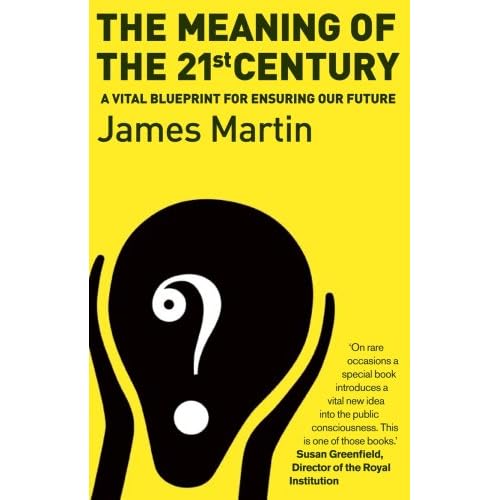
Review: The Meaning of the 21st Century by James Martin


The basic thesis of this excellent book is that the 21st century will be a transformative era in human history, the book is partly in response to Lord Martin Rees' Our Final Century.

Unlike Rees, Martin is optimistic about human-beings surviving the 21st century. Martin feels that although the challenges are huge and there will be the potential for catastrophic failure (in the form of the human race ceasing to exist or civilization simply collapsing) we will still be able to tread a path to a better world.

James Martin believes that the trends in economic, demographic, technological, and social change will lead humanity into a period of history that will seem like white-water rafting after centuries of relatively smooth sailing.

Advances in areas like computing, nanotechnology, high-bandwidth communications, low-CO2 emitting power generation, genetic engineering of foodstocks and human beings, transhumanism, biotechnology, direct brain-computer links, and human augmentation will cause tremendous change and offer great promise.

But while this is happening there are also huge problems to be dealt with in the form of environmental degradation, climate change, collapsing of world fish stocks, overpopulation, nuclear war, bio-war, terrorism, failed states and poverty stricken "fourth world" countries.

After this transitional period we can build an ever more wonderful and exciting civilization.

Martin has faith in the idea of technological ingenuity and entrepreneurism solving many of the problems we are faced with.

The book reads rather like a series of slide presentations cobbled together. It's enjoyable to read and doesn't tax the mind with high-falutin' concepts (the book is apparently based on a TV series).

But I feel in his haste to make everything explicable and easy to understand Martin has left out some of the innate complexity in what he suggests.

For example his suggestions as to how to solve the problem of the development of dangerous technologies (genetically engineering viruses; cheap, portable nuclear bombs) are based around the precautionary principle, an idea I'm not entirely comfortable with.

The precautionary principle is applied when scientists are concerned that a particular line of research will lead to the creation of an immensely dangerous weapon. They will make a decision to stop pursuing that line of research.

The most obvious example is a smallpox virus, modified so as to be resistant to any vaccines that exist

The problem is that science thrives when there is a back-and-forth of knowledge and information. The precautionary principle would threaten that. If scientists decide to "hold back" in acquiring and disseminating knowledge and discoveries then the scientific community could become balkanised and fractured.

More seriously, just because one group of researchers (or their financial backers) decide to obey the precautionary principle doesn't mean there will be others who would seek their own advantage in the inaction and withdrawal of their competitors.

It is also likely that such a group will carry out their research in secret, without the overview and transparency required when dealing with potentially dangerous areas of research.

Any weapons or dangers that do emerge would then be completely hidden from everyone else, making the developments even more threatening and dangerous.

And if these weapons were used then none of the reputable and precautionary-principle obeying researchers would have the knowledge required to counteract the problem.

Although I believe advancing technology will render our current concepts of privacy irrelevant Martin is too keen to advocate extending state-control in the pursuit of terrorists.

However the vast majority of what he says makes sense. He is in favour of pebble-bed nuclear reactors, he is in favour of reducing population by educating and liberating women. He wants to extend to poor countries all the benefits and advantages of prosperous liberal democracies.

The book positively vibrates with buzz-words. One of the better ones is "eco-affluence". This is the idea that we can live happy and prosperous and enriching lives without destroying the environment. "Eco-affluence" will soon be picked up by politicians and used to describe an ideal situation for humanity.

He also discusses the idea of the singularity and non-human-like intelligence. NHL intelligence is distinct from "traditional" conceptions of AI because it concerns evolutionary programs, programs that try vast numbers of possible solutions to problems and select from those that work, learning techniques, pattern recognition and data mining.

In fact it concentrates on what computers have potential for and leaves human minds to do the stuff we have potential for, in conjunction with our computer helpers.

In conclusion, this is a must-read for everyone, particularly if you need a basic primer on where we're going as a species, the challenges we are faced with, what the opportunities are, and what human civilization will look like 92 years from now.