Showing posts with label futurism. Show all posts

Tuesday, February 15, 2011

Moore's Law and Structural Deepening

Apropos Tyler Cowen's book The Great Stagnation: How America Ate All The Low-Hanging Fruit of Modern History,Got Sick, and Will (Eventually) Feel Better.

Matthew Yglesias points to Kevin Drum pointing out that:

World-changing inventions just don’t come around all that often, and when they do it takes a long and variable time for them to become integrated enough and advanced enough to have an explosive economic effect. Steam took the better part of a century, electrification took about half that, and computers — well, we don’t really know yet. So far it’s been about 60 years and obviously computers have had a huge impact on the world. But I suspect that even if you put the potential of AI to one side, we’re barely halfway into the computer revolution yet. To a surprisingly large extent, we’re still using computers to automate stuff we’ve always done instead of actually building the world around what computers can do.


This reminds me of W. Brian Arthur's book The Nature of Technology and Arthur's idea of structural deepening (as described here).

Yglesias has his own theory that advances in computer technology have in fact been "un-optimally" rapid. We have come to expect that new and improved computer technologies will arrive so soon that it isn't really worth refining an existing paradigm. Therefore structural deepening hasn't really happened in Arthur's sense of the term. There has instead simply been a succession of straightforwardly better technologies.

Tuesday, February 17, 2009

Realisable fusion power

I commented on this fusion-fission hydrid reactor design on Futurismic a while ago.

Researchers at the university of Texas are developing a means to process spent nuclear fuel using fusion:

The scientists propose destroying the waste using a fusion-fission hybrid reactor, the centerpiece of which is a high power Compact Fusion Neutron Source (CFNS) made possible by a crucial invention.

The CFNS would provide abundant neutrons through fusion to a surrounding fission blanket that uses transuranic waste as nuclear fuel. The fusion-produced neutrons augment the fission reaction, imparting efficiency and stability to the waste incineration process.

The reason this is exciting is that it raises the possibility of a way of developing fusion technologies incrementally and economically. Instead of going all-out to build a nuclear fusion reactor in one step, putative nuclear fusion companies could market their wares as a means of processing the nasty transuranic waste output of conventional fission reactors.

This would provide fusion companies with a source of revenue to develop more advanced magnetic containment methods, and many of the other technical requirements of fusion electricity production.

The problem with fusion technology in the form of the ITER project is it's a massive, expensive, centralised, all-or-nothing endeavour.

I entirely support ITER: but it I'd love to see some this fission-fusion hybrid fuel cycle implemented in practice.

Charles Stross makes this point about incremental development but concerning the LiftPort group, a consortium that have made the mistake (as Stross sees it) of focusing on the development of an elevator system under the assumption that the revenue-generating fullerene cable technology would appear from somewhere else.

Wednesday, February 11, 2009

Problems of specificity

Eleizer Yudkowsky on the virtues of specificity:

When the unenlightened ones try to be profound, they draw endless verbal comparisons between this topic, and that topic, which is like this, which is like that; until their graph is fully connected and also totally useless. The remedy is specific knowledge and in-depth study. When you understand things in detail, you can see how they are not alike, and start enthusiastically subtracting edges off your graph.

This is a problem that is ever-present online. Very rarely are online debates actual arguments, they are bickering contests between people who have completely different ideas about the actual definition of words and the scope of the debate.

I was impressed by Yudkowsky's thoughts on the three schools of the singularity because it addresses directly the oft-ignored problem of what exactly someone means when they talk about the singularity.

This was the problem with PZ Myers' objections to the singularity - he argued against a few elements of Kurzweil's thesis and used these inconsistencies to dismiss the whole thing out of hand.

I agree there are problems with various aspects of Kurzweilian singularitarianism but they need to be adressed clearly and specifically.

Delicious specificity

In a similar vein I've been trying to work out what the best way of organising my Delicious tags is.

There are some tags, like "technology", "economics", "politics", "science", and "toread" which are so wide-ranging they lose all meaning.

However if my intention is to be able to refer back to a specific article when I need a reference too much specificity can hinder my search.

Tag bundles help solve the first problem of overarching vagueness by promoting "technology", "economics", "science", and "politics" to a well-earned retirement on the board of directors {?}.

Could it be possible to build a system into Delicious whereby it is possible to say that something vaguely reminds me of something else?

I don't mean a tag like "remindsmeofStephenFry". I mean a way of tagging a document that doesn't explicitly reference Stephen Fry in any way but still reminds me of him. Something like remindsmeof:"StephenFry".

In this context remindsmeof would be a command recognised by the Delicious API to note that the article isn't explicitly about Stephen Fry but nevertheless puts me in mind of him.

I suspect that this sort of thing is less useful in practice than I imagine, particularly as much of the utility of Delicious comes from its simplicity and intuitiveness.

And as to Yudkowsky: obviously this respect for the specific can be taken too far: a general knowledge encompassing many fields can also be very valuable.

It's best to learn a lot about a little and little about a lot.

What I think of the three kinds of technological singularity

Michael Anissimov has a post up on the three kinds of singularity. This is based on this post on the three schools of singularity thought by Eliezer Yudkowsky. This is relevant to many criticisms of the idea of a technological singularity as criticisms frequently focus on minor or ancillary effects of the singularity.

As I said before, I don't "believe" in the singularity. I think it's either irrelevant or a fairly trivial observation of technological growth trends. But within the context of the three schools I think I can express my thoughts more coherently.

Here are the three kinds of singularity Anissimov and Yudkowsky describe:

  1. Accelerating change: advances in computer science, AI research, genetics, human augmentation, and biotechnology create a positive feedback of rapid technological growth. As the abilities of our tools improve and our own abilities improve through augmentation (both external in the form of personal AIs and internal in the form of intelligence-enhacements and nootropics) technological change accelerates exponentially.

  2. Event horizon: advances in computer science, AI research, genetics, human augmentation, and biotechnology lead to the creation of a greater-than-human intelligence. It is impossible for a less intelligent mind to predict the actions of a more intelligent mind so it is truly impossible to make any definitive statements about what will happen after a superintelligence (whether pure AI or strongly augmented human).

  3. Intelligence explosion: advances in computer science, AI research, genetics, human augmentation, biotechnology and neurobiology allow intelligent beings (either human or AI) to alter their own brains so as to improve their own intelligence. As intelligence is the source of all technological development this process will feed back on itself, as the slightly more intelligent beings develop slightly better ways of improving their intelligence, all the while creating amazing spinoff technologies.


Here's what I think of them:

  1. The accelerating change school of the singularity is the one I find most compelling. This is because it is both logically plausible and reflects the experience humans have had of changing technologies in the past. Technologies like electronics combine with digital computer theories to develop fast computers that go on to have a major effect on other areas of development. I think the accelerating change argument is the most coherent and reasonable depiction of a technological singularity

  2. The event horizon school is flakier. First, I have issues with the idea that greater-than-human intelligences are necessarily unpredictable, second, I don't believe that raw intellectual or cognitive ability is the primary driver for technological progress, and thirdly we have seen that it is already impossible to accurately predict all the outcomes of any technological development, let alone strong AI/posthuman superintelligence.

  3. The intelligence explosion school is flakier still. It is based on the assumption that a sufficiently powerful general intelligence would necessarily be able to comprehend how it's own mind works and know how to improve it. I do believe that as knowledge of the workings of the brain increases it will lead to real gains in various intellectual capacities, through nootropics, brain augmentation, or through brain simulation on faster substrates. Gaining additional knowledge about the brain doesn't require us to be "smarter."

With reference to the last point: the knowledge of how the brain works will be gained through trial-and-error scientific experimentation and ongoing technological development of brain-scanning technology (itself developed by trial-and-error technological tinkering), surgery (again also developed through the inductive tinkering of the barber surgeons), and neural interface technology (which is being tinkered with as I write).

Anissimov believes that all technological progress must be judged on the basis of how much closer it brings us to the existence of a superintelligent AI, because then the superintelligent AI will take over the business of technological development and create an intelligence explosion.

Anissimov describes himself as a technological determinist, as such he presumably believes social change is caused primarily by technological development. I agree with technological determinism in general but I feel Anissimov's perspective is closer to cognitive derminism: he believes technological (and hence social) change in the future will happen purely as a result of the cognition of AI.

This is at odds with our experience because the component of scientific and technological development that relies entirely on pure cognition (e.g. Einstein's development of the theory of relativity or Newton's laws of motion) is quite small compared with those which required a substantial amount empirical study (Darwin's theory of evolution) or mechanical tinkering (Faraday's law of induction).

This is a similar criticism to Kevin Kelly's idea of thinkism, where Kelly highlights the fallacy of believing you can study the universe by simulating it, without recourse to experiment to attempt to falsify your belief.

To summarise: although the development of a smarter-than-human AI will be a huge aid to our understanding of the nature of intelligence, consciousness, and the human mind there is no reason to assume the effects (though unpredictable) will include an intelligence explosion - I agree that it may help lead to an acceleration in technological development - but it will only be one part of the general acceleration.

Tuesday, February 10, 2009

Singularity and transhumanism

PZ Myers has written an interesting critique of Ray Kurzweil's thoughts on a possible technological singularity:

...not only is the chart an artificial and perhaps even conscious attempt to fit the data to a predetermined conclusion, but what it actually represents is the proximity of the familiar.

We are much more aware of innovations in our current time and environment, and the farther back we look, the blurrier the distinctions get. We may think it's a grand step forward to have these fancy cell phones that don't tie you to a cord coming from the wall, but there was also a time when people thought it was radical to be using this new bow & arrow thingie, instead of the good ol' atlatl.

We just lump that prior event into a "flinging pointy things" category and don't think much of it. When Kurzweil reifies biases that way, he gets garbage, like this graph, out.

Now I do think that human culture has allowed and encouraged greater rates of change than are possible without active, intelligent engagement—but this techno-mystical crap is just kookery, plain and simple, and the rationale is disgracefully bad. One thing I will say for Kurzweil, though, is that he seems to be a first-rate bullshit artist.

...

Kurzweil tosses a bunch of things into a graph, shows a curve that goes upward, and gets all misty-eyed and spiritual over our Bold Future. Some places it's OK, when he's actually looking at something measurable, like processor speed over time.

In other places, where he puts bacteria and monkeys on the Y-axis and pontificates about the future of evolution, it's absurd. I am completely baffled by Kurzweil's popularity, and in particular the respect he gets in some circles, since his claims simply do not hold up to even casually critical examination.

Calling Kurzweil a bullshit artist is unfair: Kurzweil is a genuinely talented inventor and engineer. His beliefs might be a little kooky to some, but I've always found his writing compelling.

Kurzweil is a spiritualist: there's nothing wrong with that. A belief in the power of some imminent superhuman AI to solve all our problems is slightly less absurd than most religious beliefs, and Kurzweil doesn't come across as the type to build a pyramid of skulls in the meantime.

But really: who honestly cares about the singularity?

Building artificial human minds may be possible within my lifetime, or it may not.

There will still be substantial technological change, even if the prime mover remains good old-fashioned human grey matter.

What I find compelling is the suggestion of where ongoing developments in biology, computing, genetics, and human augmentation may take us over the next few decades.

Among these developments are new ways of combining human intelligence with machine intelligence that result in a substantial increase along all dimensions of intellectual development (what Kurzweil calls the law of accelerating returns.)

So although the idea of the singularity has become less compelling what continues to excite me about Kurzweil's writings are his descriptions of posthumans. Partly for the good ol' SFnal sensawunda, and partly because maybe it could happen to me. Maybe I could become a posthuman.

I think the idea and potential reality of self-guided human evolution is a great idea in itself. I can take or leave the singularity.

Prof Myers also comments separately on the recent pronouncements on the future of humanity Juan Enriquez at the TED conference:

Every species also takes control over its own evolution, in a sense; individuals make choices of all sorts that influence what will happen in the next generation. You could rightly argue that they don't do it with planning and intent, but I have seen nothing that suggests that our attempts to modify our species, low tech and high tech together, are any wiser or better informed about the long-term consequences than those of any rat fighting for an opportunity to mate. We do what we do; don't pretend it's part of a long term plan that is actually prepared for all of the unexpected eventualities.

I agree with Myers up to a point: he's basically saying that developments in biotechnology and the progress of transhumanism won't happen in some big, top-down, organised way, but will rather develop as a series of steps through stochastic tinkering in the lab and (eventually) the marketplace.

The beauty of human progress is it doesn't have any long term plan: we do what we do and we tinker and experiment and find things out.

Juan Enriquez can make all the grand pronouncements about the future of humanity he likes but what he is actually trying to do is raise investment capital for his company Biotechonomy.

And Biotechonomy will pay scientists to tinker and experiment and find things out.

Such is the nature of technological advancement.

Prof Myers ends on a positive note:

Maybe this information age will have as dramatic and as important an effect on humanity as the invention of writing, but even if it does, don't expect a nerd rapture to come of it. Just more cool stuff, and a bigger, shinier, fancier playground for humanity to gambol about in.

Well I certainly agree with that.

Thursday, February 07, 2008

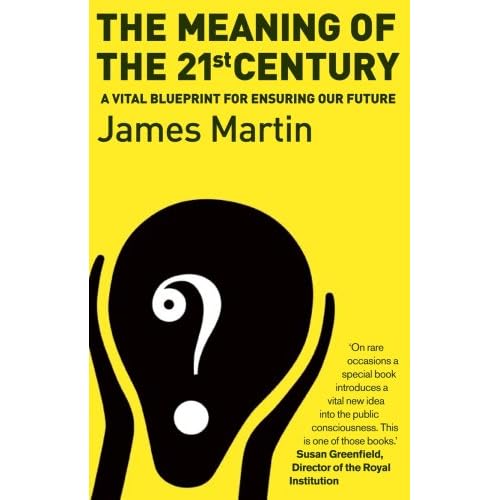
Review: The Meaning of the 21st Century by James Martin


The basic thesis of this excellent book is that the 21st century will be a transformative era in human history, the book is partly in response to Lord Martin Rees' Our Final Century.

Unlike Rees, Martin is optimistic about human-beings surviving the 21st century. Martin feels that although the challenges are huge and there will be the potential for catastrophic failure (in the form of the human race ceasing to exist or civilization simply collapsing) we will still be able to tread a path to a better world.

James Martin believes that the trends in economic, demographic, technological, and social change will lead humanity into a period of history that will seem like white-water rafting after centuries of relatively smooth sailing.

Advances in areas like computing, nanotechnology, high-bandwidth communications, low-CO2 emitting power generation, genetic engineering of foodstocks and human beings, transhumanism, biotechnology, direct brain-computer links, and human augmentation will cause tremendous change and offer great promise.

But while this is happening there are also huge problems to be dealt with in the form of environmental degradation, climate change, collapsing of world fish stocks, overpopulation, nuclear war, bio-war, terrorism, failed states and poverty stricken "fourth world" countries.

After this transitional period we can build an ever more wonderful and exciting civilization.

Martin has faith in the idea of technological ingenuity and entrepreneurism solving many of the problems we are faced with.

The book reads rather like a series of slide presentations cobbled together. It's enjoyable to read and doesn't tax the mind with high-falutin' concepts (the book is apparently based on a TV series).

But I feel in his haste to make everything explicable and easy to understand Martin has left out some of the innate complexity in what he suggests.

For example his suggestions as to how to solve the problem of the development of dangerous technologies (genetically engineering viruses; cheap, portable nuclear bombs) are based around the precautionary principle, an idea I'm not entirely comfortable with.

The precautionary principle is applied when scientists are concerned that a particular line of research will lead to the creation of an immensely dangerous weapon. They will make a decision to stop pursuing that line of research.

The most obvious example is a smallpox virus, modified so as to be resistant to any vaccines that exist

The problem is that science thrives when there is a back-and-forth of knowledge and information. The precautionary principle would threaten that. If scientists decide to "hold back" in acquiring and disseminating knowledge and discoveries then the scientific community could become balkanised and fractured.

More seriously, just because one group of researchers (or their financial backers) decide to obey the precautionary principle doesn't mean there will be others who would seek their own advantage in the inaction and withdrawal of their competitors.

It is also likely that such a group will carry out their research in secret, without the overview and transparency required when dealing with potentially dangerous areas of research.

Any weapons or dangers that do emerge would then be completely hidden from everyone else, making the developments even more threatening and dangerous.

And if these weapons were used then none of the reputable and precautionary-principle obeying researchers would have the knowledge required to counteract the problem.

Although I believe advancing technology will render our current concepts of privacy irrelevant Martin is too keen to advocate extending state-control in the pursuit of terrorists.

However the vast majority of what he says makes sense. He is in favour of pebble-bed nuclear reactors, he is in favour of reducing population by educating and liberating women. He wants to extend to poor countries all the benefits and advantages of prosperous liberal democracies.

The book positively vibrates with buzz-words. One of the better ones is "eco-affluence". This is the idea that we can live happy and prosperous and enriching lives without destroying the environment. "Eco-affluence" will soon be picked up by politicians and used to describe an ideal situation for humanity.

He also discusses the idea of the singularity and non-human-like intelligence. NHL intelligence is distinct from "traditional" conceptions of AI because it concerns evolutionary programs, programs that try vast numbers of possible solutions to problems and select from those that work, learning techniques, pattern recognition and data mining.

In fact it concentrates on what computers have potential for and leaves human minds to do the stuff we have potential for, in conjunction with our computer helpers.

In conclusion, this is a must-read for everyone, particularly if you need a basic primer on where we're going as a species, the challenges we are faced with, what the opportunities are, and what human civilization will look like 92 years from now.

Monday, December 24, 2007

Technology

I was in the Manchester Museum recently (it is rather good), and I saw a rather splendid display of bows and arrows. These were in many different styles and from many different cultures. There were little interactive displays that told you how the bows were made. An awful lot of effort and craft goes into what I had always assumed was a simple piece of wood.

Thinking about this as I struggled to operate my rapidly aging Sony Ericsson K750i it occurred to me that nowadays that level of development is rarely reached. Innovation and evolution happen so quickly that there is no point in refining a particular device. Hence mobile phones and mp3 players are rather unpleasant and tacky. Good design does crop up occasionally but the general rate of development is such that avenues of design are left unexplored and concepts are left incomplete.

Putting aside speculative discussion of a spike or singularity in the near future I sometimes wonder what “technology” and devices will really be like in, say, a thousand years time. What will human beings look like and how will they move around? In what manner will they reach orbit? Will they even bother?

In the realm of the state change seems constant and always disruptive. The pointless and dangerous desire to collate and store information is partly simply due to the technology being available to do it. This leads to accidents.

I feel privileged to live in this time of change but I do sometimes wonder if humanity will ever achieve an equilibrium with its environment. 99% of human history consists of people living in hunter-gatherer style societies. The current "singularity" we're living through will presumably result in either out destruction or in some new equilibrium. I wonder what it will look like.

Tuesday, June 19, 2007

Space, Global Warming, and Technology

Sorry I haven't written anything for a while. As I mentioned before I've spent most of the past few weeks doing exams, revising for exams, and dealing with the usual stresses that accompany these activities.

As always, an awful lot of stuff has happened over the last few days. Gordon Brown got to be Prime Minister. I'm looking forward to seeing what he'll do.

NASA is planning to launch a spacecraft called Dawn this July to study the asteroids Vesta and Ceres. When it comes to space development asteroids are the first logical source of real cash. They are large reserves of useful materials and aren't sitting at the bottom of massive gravitational wells, like most of the useful material in the solar system.

Charles Stross recently blogged a long and interesting article on space exploration and the economic difficulties of delivering cans of apes to distant star systems. I suppose we can only assume that when human civilization starts to really affect matter beyond our immediate solar system it will be through star-wisp style probes, rather than massive generation-ships, as Stephen Baxter imagines in this month's edition of Focus Magazine.

The star-wisps would carry a small payload that would be capable of "bootstrapping" itself to a more useful state using energy and material it would find when it arrives at its destination star system.

Stross makes a very good point that living in space (even in habitats like O'Neill cylinders) will probably be as difficult and uncomfortable as living on oil rigs or in the Arctic or in the Gobi Desert.

I think it's fair to say that when and if civilization begins to have a large material impact on the solar system it will not be through homo-sapiens living in bottles. It will be through artificial machines controlled by homo-sapiens living in comfort on Earth.

Global warming: From my point of view, I don't mind (in fact I would welcome) giving up personal automobile transport, but cheap international flights is one area where I feel resentful of the necessary sacrifice. A recent article at Physorg suggests the development of an electric plane. I can only assume from the article that it does not refer to an electrical jet engine, but rather to an old-fashioned propeller.


This is disappointing: currently I think the best possibility for have your cake and eat it air travel is alternative fuels, like Richard Branson has been plugging recently.

There is also the wonderful Smartfish project. The sketches of the plane look wonderful.

As for cars, driving on today's roads is an affront to the dignity of man. A sensible, low-cost/free, integrated, information-saturated and nationalised public-transport service is a necessary component of any developed nation seeking to reduce emissions of greenhouse gases.

I'm still cynical of hydrogen-gas as an alternative fuel. It seems wasteful to produce electricity to electrolyse water to produce hydrogen (assuming you don't use fossil fuels), transport the hydrogen, and then use the hydrogen to power a car or bus. It would be simpler to generate electricity and use it to charge a more conventional battery or super capacitor. There's a fascinating story on Wired about the Tesla electric sports car.

With the current hype surrounding Web 2.0 (Twitter, for example, which I have failed to use and will probably remove if it doesn't become more interesting) there have been a number of articles on the future, and how you predict it. This fascinating article on Slate about the future of the computer is an example. For all the recent advances in computer technology and communications technology we haven't even started to scratch the surface of how these two areas will transform our lives.

As computational devices ooze into the background and interfaces become more intuitive and ubiquitous (for example, Microsoft Surface) the potential for Black Swan events will increase.

All this makes predicting exactly what life will be like in the future difficult. An interesting book Imaginary Futures - From Thinking Machines to the Global Village by academic Richard Barbrook suggests that our ideas of imminent utopia have more to do with Cold War spin than any realistic analysis of potential future technology.

My own feeling is that the world is likely to get better for everyone over the next century, even as we find new and ever more cunning ways of making ourselves miserable. I suspect that at some point over the next 50 years the countries of sub-Saharan Africa, like the Sudan, Namibia, and others will experience an enormous surge in quality of life, which will make things better for everyone. Global Warming is just crammed with potential Black Swans.

I read an inordinate quantity of science fiction. I've never been able to identify precisely what I like about it: it's probably to do with the mix of optimistic escapism and extraordinary ideas.

Another interesting component is looking at what people in the past thought the future was going to be like. It seems to me that we here in Britain started the 20th century with the spectre of a European War between colonial powers hovering over our heads.

Following several decades of predicted global catastrophe (WWI, WWII, the Great Depression, the rise of dictatorships of various flavours, the creation of atom bombs and the start of the Cold War) people turned to science and technology to create a bright new future.

After this there came various waves of science fiction, dealing mostly with how people felt at the time of writing. Now that the future seems bleak again, with global warming, climate change, peak oil, and all the usual problems of Getting Along, it will be interesting to see how our view of the future changes.

With regard to this, Henry Jenkins writes about how this change in our perception of the future has affected science fiction.

I can't wait for it to be the future!

Thursday, April 19, 2007

Predictions for 2100

There is a fascinating set of predictions I read, via boingboing, concerning the year 2000, originally published in the year 1900 in The Ladies Home Journal. It is interesting to see what they got wrong and what they got right. That Nicaragua, Mexico and Brazil would ask to join the USA seems a little strange now, but I don’t know the politics of the time.

I like the sound of delivering mail by pneumatic tube, though this has been made redundant by electronic communication. There is also the usual nineteenth century obsession with the “iron cavalry”. I think the way the Victorian-era intelligentsia saw “war in the air” and “the iron cavalry” in a way similar to how we see “nanotechnological grey goo” and “wirehead meat-puppets”.

I have decided to write my own list. It is inspired by the article from the December 1900 issue of The Ladies Home Journal and is based on what little I know of current developments in science and technology. I have tried to capture the same certainty and enthusiasm of the writer of that article (a Mr Watkins) when I write of the developments in fields similar to those described in The Ladies Home Journal. Enjoy:

These prophecies are based on my own thoughts and on what I have read:

Prediction #1: The population of the Earth will exceed 10 billion by the end of the 21st century. The primary axes of political power will have shifted away from the USA. China, Malaysia, India, Russia, the EU, and a powerful “African Union” will be important global players. A social problem in the EU and Japan will be an absence of young people. The loss of oil to the Middle East will not have reduced the region’s importance in global affairs, as the meeting place of the EU, Africa, and Asia, but it remains a battle ground, rather than anywhere anyone would actually want to live. There will be more than a million people in space, in near Earth orbit, the Lagrange points, and on the Moon. The industrial exploitation of the asteroids and comets will have started, and there will be permanent colonies on Mars. Human beings will have walked on Europa (one of the moons of Jupiter).

Prediction #2: The average human being will have much greater personal choice about their appearance, intelligence, skill-set, mood, strengths, and lifestyle. Advances in cyborg technology, molecular nanotechnology, genetic engineering, neurosurgery, nootropics, and biomedical engineering will allow people to purchase personal body- and neural-upgrades. Global life expectancy will be well into the 100’s, and may be pushing 200. At some point before 2100 the majority of new children will be born via artificial methods. It will be normal to have regular and frequent back-ups of a person’s neural structures to insure against sudden, accidental death.

Prediction #3: Education will be considered a public commons, given free of charge as an inalienable human right to everyone. With improved understanding of individual psychologies, nootropics (“smart drugs”) and neural augmentation people will be able to learn more, remember more, and train faster. It will be possible to “download” different skill-sets depending on what it is you have to do. Actual work may be much closer to what we today would see as “fun”. The barrier between work and play will have almost disappeared. Access to a fairly luxurious lifestyle, with access to a certain amount of power, computing-resources, clothes, accommodation, education, information, and sustenance will also be seen as an inalienable right. Lotus-eating is frowned upon by most, and those that perform the essential and important jobs are respected, and even envied, for their importance.

Prediction #4: Transport will have become heavily integrated, with no clear distinction given between “aircraft”, “ship”, “car” or “train”. A small pod about the size of a 20th century luxury sedan, immersed within a utility-fog-style gel, will automatically transport anyone wherever they wish to go on the surface of the Earth. If they want to travel a short distance the pod will be impelled through a translucent gel that will cover most of the roads and motorways. For intra-continental distances the pod will be transferred to a maglev-style railway system. For crossing between continents the pod will rendezvous with and attach to diamantine, solar-powered airships (for a relaxing cruise), or to hypersonic jet-aircraft for a faster transfer. Despite this level of integration, there is no all-controlling system that instructs each pod on how most efficiently to travel, rather the order is emergent from the actions of individual pod AI-systems.

Prediction #5: The crisis in power-sources will have been resolved by a combination of things. Machinery will have become more efficient generally, through the widespread application of molecular nanotechnology to the manufacture of materials, and in more subtle methods of cleaning clothes and houses, and transporting people. Nuclear fission will have been used “to plug the gap” between the end of fossil-fuel-based power generation and the start of extensive nanotechnological solar-based power generation and nuclear fission. Areas where nuclear waste has been stored have, ironically, become nature reserves.

Prediction #6: Valuable materials and substances will be manufactured by plant-like organisms/devices that are farmed similarly to how crops are farmed today. These plant-like organisms/devices will be a combination of the organic and the artificial, and will produce already-refined products for use in industry and at home.

Prediction #7: Over the course of the 21st century runaway military-industrial complexes will have created horrific weapons. “Wireheaded” troops will have been used by military dictators and others. These soldiers will have drug-drips and electrical charge-generators installed in their brains so that they are supernaturally loyal to their commanders. High precision manufacture of poisons and biological viruses will mean the threat of “biological terrorism” remains as high as ever. With increased general use of molecular nanotechnology, “viruses” will be designed to target nanotechnological infrastructure. These viruses will be a combination of biological viruses and computer viruses. By the end of the 21st century it will have become much easier for a small group to exert influence and control over the majority. “Meme warfare” (propaganda) will become increasingly important, as how a conflict appears to the public becomes nearly as important as the conflict itself.

Prediction #8: Several space elevators will have been built. One will have its base in Malaysia, another will have its base in equatorial Africa, and another will have its base in South America. These areas will become increasingly important economically and politically as they offer the easiest access to space. Meanwhile extremely light, safe, and efficient laser-launched spacecraft will have been built and used. These will compete with the space elevators for spacebound traffic.

Prediction #9: Surveillance will have become almost total. Because of a plethora of extremely cheap, extremely small, and extremely versatile sensory devices, including cameras, artificial olfactory sensors, and “smart dust”, privacy will have become an extremely valuable commodity. Many people will barricade their homes against outside intrusion. Some people will embrace the all-seeing panopticon, and others will campaign vigorously against it. Panopticonism and antipanopticonism will become key political standpoints. The panopticon is not created solely by any one state, but is rather composed of many overlapping interests. Businesses and corporations seek to understand the behaviour of consumers more accurately. Neighbourhood-watch groups and vigilantes, private detectives, jealous lovers, concerned parents, employers, employees, government workers, journalists, and voyeurs will all contribute to the mass of observation devices.

Prediction #10: More manufacturing will be done at the local level. Distant descendants of today’s 3D printers and CAM machines will have developed to the point where anyone with a blueprint, a computer, a source of power, and a gas-supply can build anything they want. These devices will be able to manufacture food and drink, artificial organs, drugs, tools, bicycles, books, and even whole living organisms, including people. Initially there will be several different devices that produce different types of product, but towards the end of the 21st century these will all be combined into one device. A lot of manufacturing will still occur in relatively centralised factories, but these will be much closer to the consumer than before, as manufacturing will have been made more efficient and less bad for the environment. These facilities will more closely resemble organic forests than artificial factories as we know them today. The plant-like organisms/devices will also contribute a lot to the needs of industry and individuals. The lines between agriculture, manufacturing, and refining will be blurred. There will be certain items, like very large quantities of materials, products requiring exotic isotopes, and potentially dangerous devices, that will still be produced in manufacturing facilities a long way from human habitation.

Prediction #11: Biological diseases and pests will have become less prominent, but as I mentioned earlier there are still terrorists who sometimes purposefully release harmful materials into the technosphere. Many of these are harmless or annoying, like spam-email today. Others are more potentially harmful, but can generally be avoided through good sense, like phishing emails. There are analogues to today’s computer viruses and today’s biological viruses, there are also hybrid viruses that attack the neural implants and artificial organs people use. Many people are forced to maintain an artificial immune-system on top of their natural defences, and a computational firewall on top of that.

Prediction #12: At least one permanent space-based human colony will have been created, hollowed out of asteroidal rock. This colony will be powered by vast sheets of cheaply-manufactured solar collectors. The colony will be independent and self-sufficient. “Space lanes” will be mapped across the solar system. These are regions in space that are particularly conducive to the transport of people (as most goods are manufactured on site) due to the interaction of gravitational fields. These space lanes are dynamic and constantly shifting as the planets orbit the Sun.

Prediction # 13: Small probes, propelled through space by reflective sails and lasers based in the solar system, will have been launched towards Alpha Centauri and a handful of nearby star-systems. Rather than transport large amounts of sensors and bulky communications equipment between stars, the probes are designed to latch on to small asteroids or comets in the destination system. They then manufacture communications infrastructure and larger probes for exploring the destination system. These automatic outposts also serve as observatories, enabling the creation of massive-baseline telescopes when combined with observatories in the home system.

Prediction #14: Extensive use of genetic engineering will lead to the creation of several unique species of artificial animals. These animals will be designed to human specifications. There is some controversy surrounding this practice, as it is argued that the creation of creatures that cannot live healthy lives is cruel. There will be even more controversy surrounding the creation of chimeras, or human-animal hybrids. Some animals will have their intelligence dramatically increased, even to the point where they can converse with people. This will also apply to plants, with many new and colourful species created for a variety of purposes, including in industry (see above).

I have attempted to recreate the tone and attitude of the original text. It will be interesting, if anyone is still reading weblogs in 93 years time, to see wgat they have to say about what will happen in 2200, and precisely how what I've written has been proved off-the-mark, or just wrong

Saturday, November 11, 2006

It's All Just Meat

When faced with the breadth and majesty of books like The Singularity is Near, Engines of Creation and Hacking Matter it is difficult not to feel inspired and optimistic about the future. There is a particular brand of techno-progressive idealogue who can weave images in the mind as effectively as any of the technologies they predict.

There is a problem. Ray Kurzweil calls it "the argument from incredulity". The picture of a plentiful future peopled by synthetic superhumans is so compelling it registers on our internal TGTBTM (Too Good To Be True Meter) as a being unreasonably optimistic.

Most rational people who don't live within the bleeding edge of pattern-recognition technologies simply refuse to accept that the clanking, smoking, bad-for-the-environment hulks of machined metal that are what most people still associate with the word "machine" could ever turn into anything as sublimely effective and versatile as a human being.

It is interesting to look back at how technological changes have been predicted to occur and how they actually did occur. Take the widely-predicted advent of powered flight in the late Victorian era. We see those wonderfully fanciful drawings of individuals flitting around in one-man ornithopters. The artist that comes to mind is Heath Robinson, although his were probably actually drawn in the early twentieth century.

One of the great fears of the Victorians, as exemplified by the writing of H.G. Wells, was the concept of "war in the air" (the other great fear being that of the advent of powered cavalry). That WITA became a terrible reality through the Blitz of London within the lifetimes of many of those already adults during the Victorian era suggests that our current fears of GM viruses, dangerous artificial intelligences and rampant nanotechnology scenarios may not be as far-fetched as we could imagine.

I disagree with Kurzweil's sweeping "law of accelerating returns". The most compelling point he makes in support of this is that over the lifetime of the universe, complexity has tended to increase in a manner which strongly resembles an exponential graph.

However when we get down to the nitty-gritty level of technological development over the years and decades of a human lifetime "progress" (an amorphous term in this debate) seems to happen in fits and starts, and is strongly influenced by political and economic factors.

That a young (perhaps 20 year-old) Victorian in 1900 growing up in a world without heavier than air flight could live to see the Apollo and the Moon landings (Bertrand Russell (1872-1970) springs to mind) is an extraordinary thing.

Another point to consider before dismissing Kurzweil entirely is the nature of technological change. The counterpart of the technology of aircraft in the early twentieth century is the development of computers in the late twentieth and early twenty-first century. Computers tend to affect things in ways that were difficult to comprehend beforehand. Highly efficient information management and versatile and decentralised communication generate a lot of side-effects that would not be immediately obvious to someone who was not aware of computers.

Spime and conversion and the gradual move from centralised manufacturing towards decentralised CAD/CAM machines will allow the effects of abundant, effective computing to move from the world of pure information to the real world the rest of us inhabit.

At the moment our world is still very much run by meat. Humans are required for their versatility and imagination, if for little else. I think that of all Ray Kurzweil's predictions, the most likely to turn out to be correct is his belief that there will be a strong convergence between human and machine intelligence with the result of an (even more) profound change in the way the world works.

Friday, August 18, 2006

Huzzah!

Contrary to my personal predictions, I got ABBB in AS English, chemistry, maths and physics. I'm very pleased with this. The universities I am considering applying for are UCL, Bath, Manchester and Birmingham (possibly Leeds, Bristol, Sheffield, Edinburgh, York...) and these unis have AAB/ABB/BBB as their "typical grade offering". I reckon if I retake two of physics, chemistry or maths (probably maths and chemistry) then I'll be able to up the B-grades to A-grades and go on to get (at least) three B-grades for A2.

Like I said before, when I go to university I'd like to do chemical engineering or biotechnology or computer science or something. I don't have much idea to be honest, but chemical engineering is certainly near the top of my list.

The car I'm going to buy has to have a little work done on it (windscreen wipers, new tyres), but I should have acquired it before I go back to school in September. I have a driving lesson this Sunday and work tomorrow. I've got to spend a lot of the next two weeks working on chemistry coursework.

I'm going to go to the University of London Open Day on the 12th or 13th of September, and I'm also going to Manchester on the 4th.