Showing posts with label science. Show all posts

Tuesday, July 27, 2010

Economics, and similar

I left the following two comments on this post my Mario Rizzo, which was commenting on this post by Brad DeLong:

Brad DeLong is ot making an epistemological point, he is simply saying that there are two kinds of people who call themselves economists:

1) Hacks
2) People who study the economy

He does not claim that economists in sense 2) do not create theories to explain economic behaviour, he is simply claiming that there are are a large number of economists in sense 1) who create models containing assumptions that lead to those models leading to conclusions that are conducive to the desires of powerful individuals.


and

“ot” should be “not”, of course.

And can I confirm, Mario Rienzo, that you think that people who sincerely try to understand things about the world are “pathetic” and of the same order of moral depravity as people who deliberately try to undermine the free and fair discussion of ideas by pushing ideas that favour their own interests whilst knowing these ideas to be wrong?


Go read both posts and tell me what you think.

Friday, May 29, 2009

A (very) short story

There are many of these now. Hollow spheres and cylinders, mostly. Some cylinders. A few rods. The occasional torus. An endless fecundity of green worlds.

In the old days before fittle they thought the only way to colonise the universe was by throwing gunk out into space forever. Fapping out an endless stream of phlegm into the face of God in the hope that at some then-unimaginably distant point in the future and at some absurdly remote location the biomatter might just evolve into something you could play poker with.

At least I think that is what they believed. Corruption and degradation are a constant in this entropic universe. So it is said.

Lost in the strata of history we might find the truth of it, there are billions of dead worlds down there. Trillions of corpses that lived full and happy lives and some more that did not. Perhaps with them lies the truth of it. Where we came from.

They might have been Giants, of course, as the legends say. They might have been Gods. Or giant robots. Or intelligent waves of probability and potential. We might even have developed through a process of blind native favouritism.

All we know is what is remembered. And what we remember most of all is the name that was given. Our name.

We are the diatoms.

Monday, May 11, 2009

Laughter as an error-correction mechanism

Some bloke called Carlo Strenger has written a superior article on enlightenment values:

...the Enlightenment has created an idea of immense importance: no human belief is above criticism, and no authority is infallible; no worldview can claim ultimate validity. Hence unbridled fanaticism is the ultimate human vice, responsible for more suffering than any other.
...
it applies to the ideas of the Enlightenment, too. They should not be above criticism, either. History shows that Enlightenment values can indeed be perverted into fanatical belief systems. Just think of the Dr Strangeloves of past US administrations who were willing to wipe humanity off the face of the earth in the name of freedom, and the – less dramatic but no less dismaying – tendency of the Cheneys and Rumsfelds of the GW Bush administration to trample human rights in the name of democracy.


As one of the commenters points out, the profound principle that both 20th century secular ideologues and religious authorities throughout history have ignored, is that of always bearing in mind the possibility you might be dead wrong.

The healthy human response to harmless error or misunderstanding is to have a laugh. Thus error is highlighted for all to see and forgiven by all parties.

A further mistake on the part of humorless fanatics everywhere is to assume that there can ever be one, insoluble, and eternal truth. It may be that such a thing exists, but it is likely to be beyond our capacity to discern its true form from the vague shadows on the walls of our epochal cave.

And so human beings are prone to error. There's no problem with this, as failure teaches us more than success.

This idea was only properly articulated by Karl Popper in the 20th century: it is the idea you can never conclusively prove that an idea is correct, but rather disprove false ideas.

And so human knowledge grows and the enterprise of civilization advances, one laughter-inducing blooper at a time.

Tuesday, February 24, 2009

On The Origin of Wealth

After a brief hiatus I have started reading this book again. Everything Taleb has written, sans the epistemic philosophy and general snark, can be seen as a subset of this book.

As I read Beinhocker is discussing how the observation that businesses evolve in the marketplace can be applied to practical strategy. He makes the point that for the most part conventional strategy and long-term planning is futile in the face of the complex non-linearities of the marketplace.

Beinhocker grounds his descriptions of economic activity in modern physics itself, rather than attempting to ape physics as many early economists (like Jevons and Walras) did.

Beinhocker defines wealth as useful order. And order is information, and useful information is knowledge. So knowledge is wealth.

Beinhocker says that value is created by:

• Irreversible actions
• Local reductions of entropy and
• Fitness

Fitness is determined by an evolutionary process, the free market, which can be thought of as a knowledge-generating machine.

Beinhocker advocates ideas similar to Alex Harrowell of the Yorkshire Ranter (who I suspect is familiar with the book), stating that we need to build institutions that evolve more effectively.

This sentiment runs counter to many traditional conceptions of Big Man, top down, authoritarianism. Politicians are praised for ignoring evidence and not adapting to circumstances.

The scientific method and free markets work so well because they lead to the creation of a large number of ideas and then subject each idea to testing, selecting the most successful ones, replicating and recombining these successful ideas, then repeating the whole process continuously.

The outcome is a an increase in knowledge, and hence wealth.

Tuesday, February 17, 2009

Realisable fusion power

I commented on this fusion-fission hydrid reactor design on Futurismic a while ago.

Researchers at the university of Texas are developing a means to process spent nuclear fuel using fusion:

The scientists propose destroying the waste using a fusion-fission hybrid reactor, the centerpiece of which is a high power Compact Fusion Neutron Source (CFNS) made possible by a crucial invention.

The CFNS would provide abundant neutrons through fusion to a surrounding fission blanket that uses transuranic waste as nuclear fuel. The fusion-produced neutrons augment the fission reaction, imparting efficiency and stability to the waste incineration process.

The reason this is exciting is that it raises the possibility of a way of developing fusion technologies incrementally and economically. Instead of going all-out to build a nuclear fusion reactor in one step, putative nuclear fusion companies could market their wares as a means of processing the nasty transuranic waste output of conventional fission reactors.

This would provide fusion companies with a source of revenue to develop more advanced magnetic containment methods, and many of the other technical requirements of fusion electricity production.

The problem with fusion technology in the form of the ITER project is it's a massive, expensive, centralised, all-or-nothing endeavour.

I entirely support ITER: but it I'd love to see some this fission-fusion hybrid fuel cycle implemented in practice.

Charles Stross makes this point about incremental development but concerning the LiftPort group, a consortium that have made the mistake (as Stross sees it) of focusing on the development of an elevator system under the assumption that the revenue-generating fullerene cable technology would appear from somewhere else.

Tuesday, February 10, 2009

Singularity and transhumanism

PZ Myers has written an interesting critique of Ray Kurzweil's thoughts on a possible technological singularity:

...not only is the chart an artificial and perhaps even conscious attempt to fit the data to a predetermined conclusion, but what it actually represents is the proximity of the familiar.

We are much more aware of innovations in our current time and environment, and the farther back we look, the blurrier the distinctions get. We may think it's a grand step forward to have these fancy cell phones that don't tie you to a cord coming from the wall, but there was also a time when people thought it was radical to be using this new bow & arrow thingie, instead of the good ol' atlatl.

We just lump that prior event into a "flinging pointy things" category and don't think much of it. When Kurzweil reifies biases that way, he gets garbage, like this graph, out.

Now I do think that human culture has allowed and encouraged greater rates of change than are possible without active, intelligent engagement—but this techno-mystical crap is just kookery, plain and simple, and the rationale is disgracefully bad. One thing I will say for Kurzweil, though, is that he seems to be a first-rate bullshit artist.

...

Kurzweil tosses a bunch of things into a graph, shows a curve that goes upward, and gets all misty-eyed and spiritual over our Bold Future. Some places it's OK, when he's actually looking at something measurable, like processor speed over time.

In other places, where he puts bacteria and monkeys on the Y-axis and pontificates about the future of evolution, it's absurd. I am completely baffled by Kurzweil's popularity, and in particular the respect he gets in some circles, since his claims simply do not hold up to even casually critical examination.

Calling Kurzweil a bullshit artist is unfair: Kurzweil is a genuinely talented inventor and engineer. His beliefs might be a little kooky to some, but I've always found his writing compelling.

Kurzweil is a spiritualist: there's nothing wrong with that. A belief in the power of some imminent superhuman AI to solve all our problems is slightly less absurd than most religious beliefs, and Kurzweil doesn't come across as the type to build a pyramid of skulls in the meantime.

But really: who honestly cares about the singularity?

Building artificial human minds may be possible within my lifetime, or it may not.

There will still be substantial technological change, even if the prime mover remains good old-fashioned human grey matter.

What I find compelling is the suggestion of where ongoing developments in biology, computing, genetics, and human augmentation may take us over the next few decades.

Among these developments are new ways of combining human intelligence with machine intelligence that result in a substantial increase along all dimensions of intellectual development (what Kurzweil calls the law of accelerating returns.)

So although the idea of the singularity has become less compelling what continues to excite me about Kurzweil's writings are his descriptions of posthumans. Partly for the good ol' SFnal sensawunda, and partly because maybe it could happen to me. Maybe I could become a posthuman.

I think the idea and potential reality of self-guided human evolution is a great idea in itself. I can take or leave the singularity.

Prof Myers also comments separately on the recent pronouncements on the future of humanity Juan Enriquez at the TED conference:

Every species also takes control over its own evolution, in a sense; individuals make choices of all sorts that influence what will happen in the next generation. You could rightly argue that they don't do it with planning and intent, but I have seen nothing that suggests that our attempts to modify our species, low tech and high tech together, are any wiser or better informed about the long-term consequences than those of any rat fighting for an opportunity to mate. We do what we do; don't pretend it's part of a long term plan that is actually prepared for all of the unexpected eventualities.

I agree with Myers up to a point: he's basically saying that developments in biotechnology and the progress of transhumanism won't happen in some big, top-down, organised way, but will rather develop as a series of steps through stochastic tinkering in the lab and (eventually) the marketplace.

The beauty of human progress is it doesn't have any long term plan: we do what we do and we tinker and experiment and find things out.

Juan Enriquez can make all the grand pronouncements about the future of humanity he likes but what he is actually trying to do is raise investment capital for his company Biotechonomy.

And Biotechonomy will pay scientists to tinker and experiment and find things out.

Such is the nature of technological advancement.

Prof Myers ends on a positive note:

Maybe this information age will have as dramatic and as important an effect on humanity as the invention of writing, but even if it does, don't expect a nerd rapture to come of it. Just more cool stuff, and a bigger, shinier, fancier playground for humanity to gambol about in.

Well I certainly agree with that.

Monday, February 09, 2009

The fifth element

In the Western classical tradition there were believed to be four elements from which everything in the human world was made. They were earth, air, fire, and water.

Every object in the human world was believed to consist of different proportions of these four elements.

Of course in order to combine these elements together into objects there needed to be a fifth element, which Terry Pratchett calls the element of surprise.1

Surprise is a funny thing: an emotional response in a rational context. You think one thing, something changes, and then you think another thing. They've forgotten my birthday, every jumps out at you, they haven't forgotten your birthday!

Why do we feel surprise? Is it an evolutionary adaptation to finding out that things are other than they are? Does it act as a kind of exclamation mark for the mind to highlight the importance of a change in the universe or is it simply a high-order emergent property of consciousness that serves no really useful purpose?

Do animals feel surprise in the same way as humans? Are there qualitative difference amongst surprises?

Intellectual surprises are the most fun, over at Overcoming Bias Robin Hanson asks what would have surprised our hunter-gatherer ancestors about how we view the world today?

The answers boil down to a couple of basic points:
  1. The universe is far bigger and older than expected.
  2. Everything in the universe is actually composed of a surprisingly small set of items operating on the basis of a surprisingly simple set of rules. Complex things emerge from these simple rules.
The loss of determinism to quantum physics was also suggested.

As an SF fan I'd love to fast forward a few thousand years to see what things we will discover in the future that will surprise me.

There is a strong temptation to fall into the trap if thinking "we've got this science thing basically nailed down except for a few small details."

One of the most compelling things about life is surprise: the act of discovering something is other than you expected and that things are not as they initially seem.

{Incidentally if this post seems a little off it's because I've had difficulty sleeping recently and I'm currently very tired... ;)}

1: Actually the original fifth element was quintessence, which accounts for all the stuff in the "heavenly realm" of the sky that didn't obviously consist of any of the other four.

Saturday, February 07, 2009

The quantum leap intelligence problem: are posthumans ineffable?

There is an idea prevalent in transhumanism that when posthumans or strong AI finally develop they will be to us as we are to the beasts that perish. They will be so much more intelligent that we will be incapable of understanding them.

They will possess super-science mojo and will live in mathematically optimal blocks of matte computronium, and they will have awesome tech that we puny baselines won't be able to distinguish from magic. They will be ineffable and godlike and we simply won't be able to understand them or their motives.

(Aside: for the sake of brevity for the remainder of this post I will refer to "them and us" to distinguish baseline humans from posthumans - not because I don't buy into the whole Kurzweil machine-human merger, but just because it's easier to write about)

I disagree with this idea of posthuman ineffability.

The idea suggests that there are other ways of being intelligent (i.e. possessing a highly accurate model of the outside universe and a highly accurate model of yourself and your fellows, thereby enabling self-reflection, communication, and culture 1) that are an entire quantum-leap above human intelligence such that we won't be able to comprehend them or their actions.

Michael Anissimov has written an interesting article making the point that human beings are dumb. In fact we possess only the bare minimum of intelligence required to create the civilization we have now.

Michael Anissimov makes some good points in this article on the current state of human intelligence:

Hey, human philosophers — I’ve got some bad news. It turns out that Homo sapiens probably isn’t the qualitatively smartest possible being.

...

How do I know? Well, most other members of the genus Homo had plenty of time to build agricultural civilizations, but they were too unintelligent to get off the ground. Homo sapiens was just barely smart enough to do the trick. And like a self-replicating machine that moves from 99.9% closure to 100% closure, the payoff was big.

I agree with this as far as it goes. All it took to develop complex social technologies like language and complex physical technologies like bows and arrows was a small increment in intellectual capacity.

We made that quantum leap from animal to human around 100 000 years ago: in the intervening period we haven't evolved a great deal (in fact, some say we've stopped evolving at all).

Ergo we are possessed of the bare minimum intellect required to sustain and develop technological civilization.

Anissimov uses this as an argument in favour of the idea that there there are many more superior modes of intelligence that we haven't yet developed or encountered, or in his words:

The apparent magnitude of our accomplishments, including those of Einstein, is merely a side-effect of how low our standards are. To another species on another world whose intelligence was crafted in the furnace of selection pressures more intense than ours, quantum mechanics is obvious from the get-go. The only thing funnier about how dumb we are to take so long to figure it out is our self-importance at having finally figured it out.

This is where I disagree with Anissimov. I think that the miniscule quantum leap between pre-human animals and human beings is a one-time event. Improvement is certainly possible, but to claim that there is some qualitatively and quantitatively different perspective on the universe that is definitively superior in every measurable dimension to human thought and would result in beings that we are incapable of understanding is incorrect.


Here's why:

  1. Human knowledge and understanding does not progress wholly through deductive reasoning or pure cognition. In fact a large amount of human knowledge and understanding comes from what Nassim Nicholas Taleb calls stochastic tinkering, and Eric Beinhocker calls deductive tinkering. Trial and error and accident has contributed enormously to the development of human knowledge. Presumably a posthuman would make mistakes: otherwise how would it learn? And if it doesn't learn how does it grow and develop?
  2. I agree with Kevin Kelly that there is a fallacy in the idea of "thinkism." Thinkism is the idea that it is possible for a mind, completely ignorant of the workings of the physical universe, to consider a few small objects, like a rock, flower, a feather, and a model of a galaxy embedded in amber, and then use these items to deduce the workings of the physical universe without any recourse to experiment. It could well be that there are other universes with different physical laws that could generate those items and without recourse to experiment how would this mind know which universe it lived in?
  3. We will share the same universe (they may go elsewhere, of course, but the chances are baselines will stay here): as such this posthuman entity will be subject to all the usual laws of entropy, conservation of energy, gravity and whatnot. As such this posthuman will need things and do things that are explicable to us. Only by creating a solipsistic alternate-reality computer bizarro world could a posthuman behave in a completely ineffable fashion: and even then a posthuman would still be subject to the axioms of a given logical or mathematical environment. N-incomplete problems would remain so.

Looking at point 1 "how does a posthuman learn" suggests an interesting counterargument: "posthumans develop in a way that doesn't involve learning, they use something different and ineffable."

The problem with this counterargument is that what I'm arguing is empirically refutable: the existence of a truly ineffable posthuman entity is something that is observable, so my point can be refuted by the observation of one posthuman entity whose motives and actions we do not understand. However transhumanist thinkers can continue asserting that true posthumans are by definition ineffable until the end of time. I predict that as posthumans emerge and their actions are studied they will eventually always be found to be explicable by baseline humans (if weird and peculiar - see below).

I agree that there are almost certainly better modes of intelligence, but I disagree with the idea that these modes of intelligence will ever be wholly incomprehensible to baseline humans.

They may be faster, cleverer, wittier, more attractive, stronger, longer-lived, instatiated within superior hardware, and better at poker - but it doesn't mean baseline humans would be incapable of understanding them.

The distinction between what I'm arguing and what Anissimov implies in his article is fairly subtle, and I could be accused of nit-picking, but I think it's important that we realise that there is no reason to assume posthumans will be completely and utterly ineffable to us, at least not if they want to survive IRL (which they may not).

That humans have accomplished what we have says more about the power of the evolutionary methods of stochastic tinkering combined with occasional deductive reasoning than it does about the brilliance of human intellect: and this is exactly what Anissimov is saying and why I agree with the premise of his article.

But once you possess culture (what Ian Stewart and Patrick Cohen call extelligence, or what Richard Dawkins might term "a memetic environment"), and a reasonable means of manipulating the universe it doesn't matter how "smart" you are. Trial and error and learning and robust heuristics take care of the rest.

I believe that some posthumans will be pretty weird, some may be charismatic, some may be frightening. But we can get to where they are, they are post-humans and they took a path we will be able to follow. Because of this and for the reasons given above I don't believe posthumans or posthuman civilization will ever be truly ineffable.


1: In fact it could be that this superior intelligence works on a completely different basis to creating a highly accurate model of the universe and the self, and works on some other basis that we can't comprehend. This non-intelligent "intelligence" would be truly ineffable and would completely disprove my point if it actually was superior in every possible way to human intelligence.

Further reading: if you do understand precisely what I'm trying to say I should mention that it isn't original, Greg Egan argues something similar in the opening chapter of Schild's Ladder.

Friday, January 02, 2009

What I'm reading now


  • M150 Data, Computing and Information: Unit 5 Storing, getting and sending your data, OU.

  • T173 Block 3 Patents: The engineer as innovator, OU.

  • The Quark and the Jaguar: Adventures in the Simple and the Complex by Murray Gell-Mann.

  • Sams Teach Yourself Java 6 in 21 Days by Rogers Cadenhead and Laura Lemay.

  • Economics for Dummies by Sean Masaki.

  • Four Laws That Drive the Universe by Peter Atkins.


I recently (and finally) finished reading Arthur Koestler’s The Sleepwalkers. It was referenced in The Black Swan by Nassim Nicholas Taleb.

Taleb said that Koestler highlighted how the idea that science has progressed in a straightforward fashion is wrong. Science has evolved through a series of sudden breakthroughs, and with much time wasted in intellectual dead-ends.

Taleb describes the most valuable property of the scientific method and the free market as “stochastic tinkering.” Having lots of people messing around with different ideas and business models increases your exposure to potential breakthroughs.

The idea that history is a series of clear and well defined developments inevitably leading to some outcome is a canard. History is a random and chaotic process.

Science and the free market are also random and chaotic. However it is precisely because of this randomness that science and the free market are so powerful.

Because the free market encourages new ideas and methods and allows successful ideas to achieve success at the expense of less successful ideas the ultimate outcome is a system that maximises the potential for good ideas to achieve widespread adoption.

Similarly with science. Good ideas succeed at the expense of bad ones. However in the scientific method the ideas are judged on the basis of the successful predictions they make, or the fact that they have yet to be disproved by experiment.

In the free market good ideas are judged on the basis of how profitable they are (theoretically).

Gell-Mann touches on many of the same ideas as Taleb, particularly regarding complexity and what Gell-Mann refers to as “complex adaptive systems.”

Wednesday, December 10, 2008

The perfect job?

Jason Stoddard writes of the difficulties of being a science fiction writer in 2008 [via Futurismic] and describes what sounds to me to be pretty much my ideal job:

To write fully believable, near future science fiction today, you almost need to be voracious antisocial polymath, deeply conversant in half a dozen technical fields, as well as familiar with ongoing social, economic, and environmental change.

...

And that’s the burden of the modern science fiction writer. If you want to write believable near-future fiction, you can’t choose a single point of advancement. You need to have a good understanding of advances in many different fields, and you need to be able to imagine how these can come together, for good or for bad. And to be really believable, you’ll need to know more than you ever wanted to know about how the world works, economically and socially, as well as where the trends are heading.

This is actually pretty close to being my ideal career - a sort of polymath technocrat who spends half his time researching and half his time writing stories. Jeremiah Tolbert disagrees [again via Futurismic], saying that:

I take exception to is the notion that you need to be deeply conversant in anything. I think you just need to do research to the point where what you have to say doesn’t break the suspension of disbelief and I think that’s a long ways from being a polymath. You don’t need to be an expert on anything but people.

Well I agree with this as well. I wouldn't be adverse to doing the whole bleached-skin, eccentric-reclusive paranoiac thing (like Neo in the first Matrix movie or the oil rig dude in The Star Fraction) but I would like to get out sometime.

Saturday, December 06, 2008

Discussion of ethics, capitalism, the environment, and what I should do with my life

I have been reading The Business by Iain Banks. It is an engaging read, despite the treacle-slow plot, and has plenty of the kind of feats of imagination that I like about Banks’ writing.

The main protagonist is a mid-to-high-level manager in “the business” – a generation-spanning organisation that supposedly bought the Roman Empire (but only for 66 days), owns several sets of crown jewels, and is as ubiquitous as it is unnoticed.

The internal set-up of the business is explored in some detail; it is vehemently rationalist, secular, meritocratic, and organised to avoid corruption, nepotism, and dynasty-building as these things are seen to get in the way of effective money-making.

As ever Banks’ imagination and prose add a great deal to the story, and his politics shines through as clearly as usual. Several pages are given over to debates about inequality, opportunity, capitalism, and the pros and cons of free markets and the state.

I am currently at 312/392 pages. I don’t know if there will be a twist at the end or not, but the book has already given me food for thought on a subject that has been worrying me for some time now.

I am currently 19 years old and in the very fortunate position of being able to choose how, where, and in what manner I wish to live my life. This is not a choice most people are offered. As such, I have been vacillating over the appropriate direction to take. Do I want to dedicate my life to the service of some greater good, or do I want to pursue my own aims and personal ambitions?

Reading A.C. Grayling’s The Choice of Hercules: Pleasure, Duty, and the Good Life in the 21st Century has helped a little. In the book Grayling argues that the idea that we have to choose whether to devote our lives to vice or virtue is a false one. At the same time H.J. Blackham’s Humanism suggests that I have a responsibility to myself, and a responsibility to everyone else by virtue of our common experience of humanity. Balancing the two is addressed by Grayling quite well in his book.

In any case the real cause of my concern over what path to take stems from the ideas explored in The Business. Is acquisitiveness good? Is greed good? Is it better to seek to grow and expand your wealth or persue other interests entirely?

Quite often this argument is subsumed by other arguments about capitalism vs. socialism; of free markets vs. state control; traditional morality vs. human nature; and arguments over the best way to raise people out of poverty and end tyranny and bloodshed.

These kind of political, economic and social arguments devolve to deciding whether or not our current system of liberal democratic capitalism (as typified by the USA, Japan, and the EU) is the best resource/scarcity-allocating system.

The definition of “best” is open for debate as well. Anyone asking for my beliefs on what is best should read the Universal Declaration of Human Rights, then read up on utilitarian philosophy and the golden rule. For the purposes of the rest of this essay I will assume “best” means that all resources are allocated in a manner which leads to an ending of human poverty ASAP, an ending to war, and provision for ensuring sustainable use of finite resources (read: avoiding anthropogenic climate change, preserving and enhancing biodiversity, repairing some of the damage we have already done to the environment and ensuring that in the long run human activity has a neutral effect on the environment).

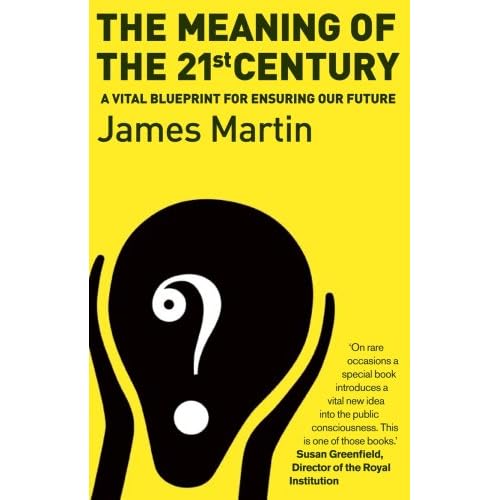
This is a tall order for any prospective resource-allocation system, but I am confident it can be accomplished. The best book I’ve read on the subject of ensuring continuing and growing prosperity for all whilst maintaining the environment is The Meaning of the 21st Century: A Vital Blueprint for Ensuring Our Future by James Martin. In the book Martin argues for something called “eco-affluence.” Martin believes that with a combination of freer markets, more education (especially for women), and advanced technologies (most notably extensive use of genetic engineering, nuclear power, and hydroponics) we will be able to simultaneously solve our environmental and humanitarian problems. He makes an excellent case for the fact that they are one and the same problem, and that attempting to solve one whilst disregarding the other will end up exacerbating both.

From an objective perspective it is clear that if a better resource/scarcity-allocating system than liberal democratic capitalism ever emerged then we should immediately adopt it. Some might point to China’s model of state capitalism as an alternative solution, but they miss the point that what matters is quality of life. Most evidence suggests dictatorships are simply institutionally incapable of behaving in a benign manner.

Can you do good simply by aiming to become rich? You create jobs, you increase public tax revenues and hence the amount of money spent on welfare, hospitals, schools, etc. If you do it properly you create an environmentally sustainable business that provides people with a good service. You will probably have a lot of fun once you acquire wealth and then you can give it all away before you die.

There are a couple of ways of looking at problems in the world. One argument would be to say that the problem is corporatism. Whenever the needs and desires of an abstract collective are put above the needs and desires of individuals you get problems. An example that springs to mind is that of environmentalism. Environmentalists have an unfortunate habit of treating people as “the problem” rather than the only reason it is worth solving the problem.

In The Business “the Business” is a mechanism for allowing the flourishing of individuals – or is it a controlling corporate regime?

John Marnard Keynes, the economist whose theories of fiscal stimulus are currently being implemented by our politicians saw capitalism as a means to an end, a multi-generational project for creating wealth, growth, and technological innovation. His concept of capitalism was that it is a necessary evil; a mechanism for creating a greater good.
In his essay The Economic Possibilities of Our Grandchildren Keynes writes that:

The strenuous purposeful money-makers may carry all of us along with them into the lap of economic abundance. But it will be those peoples, who can keep alive, and cultivate into a fuller perfection, the art of life itself and do not sell themselves for the means of life, who will be able to enjoy the abundance when it comes.
It could be said that Keynes is too utopian – and that he doesn’t realise that humanity is inherently acquisitive and irrational. Maybe markets emerge naturally in all human societies?

To return to Iain Banks – A Few Notes on the Culture is well worth reading on the subject of what (I hope) a post-scarcity civilisation looks like.

And also (via Ken MacLeod) this libertarian commentary on the idea of "success" from Brian Micklethwait.

And finally, because this is a blog after all, what about me? What should I do? Start a business? Go study bioinformatics? Go study economics? Go study systems engineering? Write novels?

Tuesday, October 28, 2008

...or were you looking at the Woman in the Red Dress?


Researchers have discovered that the colour red enhances men's attraction towards women:

the women shown framed by or wearing red were rated significantly more attractive and sexually desirable by men than the exact same women shown with other colors. When wearing red, the woman was also more likely to score an invitation to the prom and to be treated to a more expensive outing.

Apparently this will have implications for dating and product design, but I think that they've already been taken on board in these contexts.

Sunday, September 28, 2008

Comment on "The Sleepwalkers" by Arthur Koestler

The Sleepwalkers by Arthur Koestler, is a history of the study of the cosmos, starting with the ancient Babylonians and ending with a discussion of Newton, via Aristotle, Plato, Copernicus, Kepler, Galileo.

Koestler seeks to demolish the assumption that the history of this particular subset of science is a Whiggish story of Progress towards a Theory of Everything. Rather it is a story of various people blundering around and gradually and haphazardly building a picture of the universe.

These philosophers and scientists "sleepwalk" towards understanding.

Enjoyable and iconoclastic, well written but with some flaws.

Some spiritualist stuff, which comes off sounding a little odd against the otherwise respectably skeptical tone.

Claims that electromagnetism and gravity are "verbal fetishes ... disguising the fact that they are metaphysical concepts dressed in the mathematical language of physics."

Well that's an interesting perspective. I wish I knew if Koestler was speaking from a view of ignorance or understanding as regards the mathematical underpinnings of gravitational theory.

It is unfair to say gravity is a metaphysical construct. It is a theory that currently suits all available evidence very well. We believe in it because the evidence suggests it exists.

However Koestler is right to reinforce how peculiar the idea of "action at a distance" (spooky or otherwise) really is. Descartes was having none of it. Newton presented his theory of gravity but said:

"gravity must be caused by an agent acting constantly according to certain laws; but whether this agent be material or immaterial, I have left to the consideration of my readers"

Dismissive of Einstein (p 504, Chapter 3 The Newtonian Synthesis 1. 'Tis all in Pieces):

"Einstein's correction to Newton's formula of gravity is so small that for the time being it only concerns the specialist. The two most important branches of modern physics , relativity and quantum mechanics, have not so far been integrated into a new universal synthesis; and the cosmological implications of Einstein's theory are still fluid and controversial."

I think Koestler rather misses the point here: as I understand it Newton was wrong to assume space is "flat" and Einstein demonstrates that space is not flat. Newton's theories are a good approximation of what goes on in the universe, and for most purposes do well enough, but Einstein is closer to being correct than Newton.

The book was published in 1959: I think Einstein's theories were bedded down by then.

All in all, an excellent read, drawing on the original sources.

Wednesday, May 21, 2008

One Last Post...

One of the more annoying aspects of the NewsCloud is it's tendency to simplify then exaggerate.

Take science vs. religion.

The mere fact that you have some idea of what I'm talking about it disgusting. How can such a puerile expression be useful? As a mental hook for something so complex and profound (and so misunderstood) that it escapes almost all serious consideration.

In the last 24 hours the British parliament has been debating and voting on a series of issues associated with abortion (should the last date at which an abortion can happen be lowered from 24 weeks), hybrid embryo research, and saviour siblings.


Some tasteful sketches of a foetus from Leonardo da Vinci

All these are important issues. I won't comment on them because there are facets of the debate (particularly associated with abortion), which I simple don't know about.

These issues are important and as such they should be treated as such. This is not, nor has it ever been, about "science vs. religion."

That expression "S vs. R" begs so many questions it is almost impossible to dissect it without falling into the trap of dignifying the debate, but I will attempt it.

Science is a tool. It is a way of thinking about, and observing the world. Empirical evidence (input from our sensory apparatus, both biological and artificial) and recorded data acquired through empirical means are considered.

Once they have been considered scientists think of ways that any patterns, or lack of pattern, in the data can be explained. They create a hypothesis.

They then attempt to disprove the hypothesis. They create experiments that are intended to disprove their hypothesis. If a hypothesis stands up to this treatment, and the work of one scientist is corroborated by the work of many other scientists, then an hypothesis is accepted as a scientific theory.

Yes, I know there's more to it than that. Check out this document on the scientific method for more details on the subject.

Religion is many things to many people. To me it is yet another system of control, external to myself.

It is also a panacea in moments of weakness. It is a crutch and it is community. Sometimes it is good and sometimes it is bad. Sometimes it is right. Usually it is wrong.

I do not judge those who have faith. I know what faith is. It is like a powerful drug, and it can make difficult things ... less difficult. I have had faith.


It's glowing! It must be SCIENCE!

However I am entirely within my rights to call anyone who believes in the afterlife a fool and anyone who thinks the universe is run by some dude with a beard who isn't a science fiction writer of some sort (if God can't be a science fiction writer, or is not a full-time [and published] science fiction writer I quit - god is wrong and it is immoral to have faith ;-)) an idiot.

Anyway I despise how this argument is corrupted and dragged through the dirt by slavering hacks wanting to churn out copy on a "controversial" debate.

Addendum: I am entirely aware that this article is without evidence, empirical or otherwise. It is also fairly badly written. So sue me.

Tuesday, April 08, 2008

Nootropics and Alterable Brains

One of my big philosophical hangups is the nature of the Self. What defines what we are? I don't believe in the idea of soul (although I love Soul music...).

However I also believe that our physical brains are malleable enough to alter any identifiable characteristic of our personalities; our temperament, how we respond to different stimuli, how we react to situations; our emotional, social, philosophical, and intellectual temperaments...

All these can be altered by the twisting and rewiring of neurons in the brain.

This is a fascinating story in The New York Times about Dr Anne Adams, a teacher and scientist, who suffered from a neurological condition called frontotemporal dementia.

This caused her skills, abilities, and interests to shift away from mathematical, language-based, and scientific, and towards visual, spacial, and artistic.

FTD also changes your temperament.

Another story I noticed in the news today was a feature in The Independent about nootropics: these are drugs that improve the abilities of the brain in certain ways.

This sort of technology and this area of study is going to do the same for the 21st century what automobiles, HTA flight, and computers did for the 20th.

We don't even have the language required to describe many of the ideas of how our brain works and psychology and neurobiology are surrounded by myths and perceived weirdness.

Combining greater understanding with an ability to combat pathologies of the brain and even alter the brain to improve it's abilities will lead to a revolution, not just in medicine, but a revolution in what it means to be human.

Wednesday, March 05, 2008

Neil Gershenfeld

I stumbled across this talk with MIT Bits and Atoms dude Neil Gershenfeld on Edge.org from way back in 2003.

I'm too exhausted to comment on it now. But I implore you, dear reader, take a few minutes out of your day and read what Prof Gershenfeld has to say.

I'll comment on this further later.

Thursday, February 07, 2008

Review: The Meaning of the 21st Century by James Martin


The basic thesis of this excellent book is that the 21st century will be a transformative era in human history, the book is partly in response to Lord Martin Rees' Our Final Century.

Unlike Rees, Martin is optimistic about human-beings surviving the 21st century. Martin feels that although the challenges are huge and there will be the potential for catastrophic failure (in the form of the human race ceasing to exist or civilization simply collapsing) we will still be able to tread a path to a better world.

James Martin believes that the trends in economic, demographic, technological, and social change will lead humanity into a period of history that will seem like white-water rafting after centuries of relatively smooth sailing.

Advances in areas like computing, nanotechnology, high-bandwidth communications, low-CO2 emitting power generation, genetic engineering of foodstocks and human beings, transhumanism, biotechnology, direct brain-computer links, and human augmentation will cause tremendous change and offer great promise.

But while this is happening there are also huge problems to be dealt with in the form of environmental degradation, climate change, collapsing of world fish stocks, overpopulation, nuclear war, bio-war, terrorism, failed states and poverty stricken "fourth world" countries.

After this transitional period we can build an ever more wonderful and exciting civilization.

Martin has faith in the idea of technological ingenuity and entrepreneurism solving many of the problems we are faced with.

The book reads rather like a series of slide presentations cobbled together. It's enjoyable to read and doesn't tax the mind with high-falutin' concepts (the book is apparently based on a TV series).

But I feel in his haste to make everything explicable and easy to understand Martin has left out some of the innate complexity in what he suggests.

For example his suggestions as to how to solve the problem of the development of dangerous technologies (genetically engineering viruses; cheap, portable nuclear bombs) are based around the precautionary principle, an idea I'm not entirely comfortable with.

The precautionary principle is applied when scientists are concerned that a particular line of research will lead to the creation of an immensely dangerous weapon. They will make a decision to stop pursuing that line of research.

The most obvious example is a smallpox virus, modified so as to be resistant to any vaccines that exist

The problem is that science thrives when there is a back-and-forth of knowledge and information. The precautionary principle would threaten that. If scientists decide to "hold back" in acquiring and disseminating knowledge and discoveries then the scientific community could become balkanised and fractured.

More seriously, just because one group of researchers (or their financial backers) decide to obey the precautionary principle doesn't mean there will be others who would seek their own advantage in the inaction and withdrawal of their competitors.

It is also likely that such a group will carry out their research in secret, without the overview and transparency required when dealing with potentially dangerous areas of research.

Any weapons or dangers that do emerge would then be completely hidden from everyone else, making the developments even more threatening and dangerous.

And if these weapons were used then none of the reputable and precautionary-principle obeying researchers would have the knowledge required to counteract the problem.

Although I believe advancing technology will render our current concepts of privacy irrelevant Martin is too keen to advocate extending state-control in the pursuit of terrorists.

However the vast majority of what he says makes sense. He is in favour of pebble-bed nuclear reactors, he is in favour of reducing population by educating and liberating women. He wants to extend to poor countries all the benefits and advantages of prosperous liberal democracies.

The book positively vibrates with buzz-words. One of the better ones is "eco-affluence". This is the idea that we can live happy and prosperous and enriching lives without destroying the environment. "Eco-affluence" will soon be picked up by politicians and used to describe an ideal situation for humanity.

He also discusses the idea of the singularity and non-human-like intelligence. NHL intelligence is distinct from "traditional" conceptions of AI because it concerns evolutionary programs, programs that try vast numbers of possible solutions to problems and select from those that work, learning techniques, pattern recognition and data mining.

In fact it concentrates on what computers have potential for and leaves human minds to do the stuff we have potential for, in conjunction with our computer helpers.

In conclusion, this is a must-read for everyone, particularly if you need a basic primer on where we're going as a species, the challenges we are faced with, what the opportunities are, and what human civilization will look like 92 years from now.

Sunday, February 03, 2008

Systems of Thought

The way I tend to view the world is in the form of a hierarchy of systems.

  • At the most basic level everything is composed of waves, particles, and the forces that cause them to interact. It is at this level that the much-vaunted “theory of everything” will work. Other rules that work on this level are quantum physics and thermodynamics. This level is often referred to as “physics.”
  • At the next layer of complexity everything is composed of molecules that interact in various ways. This level is often referred to as “chemistry.”
  • Above we find the interactions of discrete cells in biological systems to create everything from neurons to connective tissue; from ivory to limestone.
  • The next level consists of the creations of the human mind. This is everything that exists by virtue of human beings manipulating the layers below. Tools, engineering, electrical devices and artificial artefacts all fall into this category. However not all of the things at this level are material: some are expressed as patterns of information in material. Things like language (both human and computer), philosophical concepts like truth, beauty, morality and law, systems of rules and interactions.
  • Above this comes the interactions between minds and the creations of the human mind. Politics and economics come into play at this level. So does literature. The difference between this level and the previous level is vague. Should “law” be considered something we hold within our minds or is it something we have “created” and that is held externally?
  • Above this level is the sum of human endeavour. This could be described as “culture.” It is what Kevin Kelly might term “the Technium.” It is our civilization. It is where the Singularity will happen.

Monday, January 28, 2008

Aeroplane Conveyor-Belt Problem

I have come to the conclusion that the aeroplane will take off in the aeroplane conveyor-belt problem.

The forces acting on the plane are thrust from the engines.

The conveyor-belt will simply make the wheels spin much faster than they usually do.

The purpose of the wheels on aeroplanes is to reduce the frictional effects that act in the opposite direction to the thrust from the engines.

These frictional forces will not be greater by virtue of the wheels resting on a surface moving backwards relative to the aeroplane.

*Is the British usage "conveyer" or "conveyor" ... ? I wouldn't mind except I'm very obviously using B.E. in "aeroplane" and I'd like things to be consistent.