
Friday, July 15, 2011


Tuesday, February 15, 2011
Moore's Law and Structural Deepening
Matthew Yglesias points to Kevin Drum pointing out that:
World-changing inventions just don’t come around all that often, and when they do it takes a long and variable time for them to become integrated enough and advanced enough to have an explosive economic effect. Steam took the better part of a century, electrification took about half that, and computers — well, we don’t really know yet. So far it’s been about 60 years and obviously computers have had a huge impact on the world. But I suspect that even if you put the potential of AI to one side, we’re barely halfway into the computer revolution yet. To a surprisingly large extent, we’re still using computers to automate stuff we’ve always done instead of actually building the world around what computers can do.
This reminds me of W. Brian Arthur's book The Nature of Technology and Arthur's idea of structural deepening (as described here).
Yglesias has his own theory that advances in computer technology have in fact been "un-optimally" rapid. We have come to expect that new and improved computer technologies will arrive so soon that it isn't really worth refining an existing paradigm. Therefore structural deepening hasn't really happened in Arthur's sense of the term. There has instead simply been a succession of straightforwardly better technologies.
Tuesday, February 17, 2009
Realisable fusion power
 I commented on this fusion-fission hydrid reactor design on Futurismic a while ago.
Researchers at the university of Texas are developing a means to process spent nuclear fuel using fusion:
The reason this is exciting is that it raises the possibility of a way of developing fusion technologies incrementally and economically. Instead of going all-out to build a nuclear fusion reactor in one step, putative nuclear fusion companies could market their wares as a means of processing the nasty transuranic waste output of conventional fission reactors.The scientists propose destroying the waste using a fusion-fission hybrid reactor, the centerpiece of which is a high power Compact Fusion Neutron Source (CFNS) made possible by a crucial invention.
The CFNS would provide abundant neutrons through fusion to a surrounding fission blanket that uses transuranic waste as nuclear fuel. The fusion-produced neutrons augment the fission reaction, imparting efficiency and stability to the waste incineration process.
This would provide fusion companies with a source of revenue to develop more advanced magnetic containment methods, and many of the other technical requirements of fusion electricity production.
The problem with fusion technology in the form of the ITER project is it's a massive, expensive, centralised, all-or-nothing endeavour.
I entirely support ITER: but it I'd love to see some this fission-fusion hybrid fuel cycle implemented in practice.
Charles Stross makes this point about incremental development but concerning the LiftPort group, a consortium that have made the mistake (as Stross sees it) of focusing on the development of an elevator system under the assumption that the revenue-generating fullerene cable technology would appear from somewhere else.
Wednesday, February 11, 2009
What I think of the three kinds of technological singularity
As I said before, I don't "believe" in the singularity. I think it's either irrelevant or a fairly trivial observation of technological growth trends. But within the context of the three schools I think I can express my thoughts more coherently.
Here are the three kinds of singularity Anissimov and Yudkowsky describe:
- Accelerating change: advances in computer science, AI research, genetics, human augmentation, and biotechnology create a positive feedback of rapid technological growth. As the abilities of our tools improve and our own abilities improve through augmentation (both external in the form of personal AIs and internal in the form of intelligence-enhacements and nootropics) technological change accelerates exponentially.
- Event horizon: advances in computer science, AI research, genetics, human augmentation, and biotechnology lead to the creation of a greater-than-human intelligence. It is impossible for a less intelligent mind to predict the actions of a more intelligent mind so it is truly impossible to make any definitive statements about what will happen after a superintelligence (whether pure AI or strongly augmented human).
- Intelligence explosion: advances in computer science, AI research, genetics, human augmentation, biotechnology and neurobiology allow intelligent beings (either human or AI) to alter their own brains so as to improve their own intelligence. As intelligence is the source of all technological development this process will feed back on itself, as the slightly more intelligent beings develop slightly better ways of improving their intelligence, all the while creating amazing spinoff technologies.
Here's what I think of them:
- The accelerating change school of the singularity is the one I find most compelling. This is because it is both logically plausible and reflects the experience humans have had of changing technologies in the past. Technologies like electronics combine with digital computer theories to develop fast computers that go on to have a major effect on other areas of development. I think the accelerating change argument is the most coherent and reasonable depiction of a technological singularity
- The event horizon school is flakier. First, I have issues with the idea that greater-than-human intelligences are necessarily unpredictable, second, I don't believe that raw intellectual or cognitive ability is the primary driver for technological progress, and thirdly we have seen that it is already impossible to accurately predict all the outcomes of any technological development, let alone strong AI/posthuman superintelligence.
- The intelligence explosion school is flakier still. It is based on the assumption that a sufficiently powerful general intelligence would necessarily be able to comprehend how it's own mind works and know how to improve it. I do believe that as knowledge of the workings of the brain increases it will lead to real gains in various intellectual capacities, through nootropics, brain augmentation, or through brain simulation on faster substrates. Gaining additional knowledge about the brain doesn't require us to be "smarter."
With reference to the last point: the knowledge of how the brain works will be gained through trial-and-error scientific experimentation and ongoing technological development of brain-scanning technology (itself developed by trial-and-error technological tinkering), surgery (again also developed through the inductive tinkering of the barber surgeons), and neural interface technology (which is being tinkered with as I write).
Anissimov believes that all technological progress must be judged on the basis of how much closer it brings us to the existence of a superintelligent AI, because then the superintelligent AI will take over the business of technological development and create an intelligence explosion.
Anissimov describes himself as a technological determinist, as such he presumably believes social change is caused primarily by technological development. I agree with technological determinism in general but I feel Anissimov's perspective is closer to cognitive derminism: he believes technological (and hence social) change in the future will happen purely as a result of the cognition of AI.
This is at odds with our experience because the component of scientific and technological development that relies entirely on pure cognition (e.g. Einstein's development of the theory of relativity or Newton's laws of motion) is quite small compared with those which required a substantial amount empirical study (Darwin's theory of evolution) or mechanical tinkering (Faraday's law of induction).
This is a similar criticism to Kevin Kelly's idea of thinkism, where Kelly highlights the fallacy of believing you can study the universe by simulating it, without recourse to experiment to attempt to falsify your belief.
To summarise: although the development of a smarter-than-human AI will be a huge aid to our understanding of the nature of intelligence, consciousness, and the human mind there is no reason to assume the effects (though unpredictable) will include an intelligence explosion - I agree that it may help lead to an acceleration in technological development - but it will only be one part of the general acceleration.
Tuesday, February 10, 2009
Singularity and transhumanism
...not only is the chart an artificial and perhaps even conscious attempt to fit the data to a predetermined conclusion, but what it actually represents is the proximity of the familiar.
We are much more aware of innovations in our current time and environment, and the farther back we look, the blurrier the distinctions get. We may think it's a grand step forward to have these fancy cell phones that don't tie you to a cord coming from the wall, but there was also a time when people thought it was radical to be using this new bow & arrow thingie, instead of the good ol' atlatl.
We just lump that prior event into a "flinging pointy things" category and don't think much of it. When Kurzweil reifies biases that way, he gets garbage, like this graph, out.Now I do think that human culture has allowed and encouraged greater rates of change than are possible without active, intelligent engagement—but this techno-mystical crap is just kookery, plain and simple, and the rationale is disgracefully bad. One thing I will say for Kurzweil, though, is that he seems to be a first-rate bullshit artist.
...
Kurzweil tosses a bunch of things into a graph, shows a curve that goes upward, and gets all misty-eyed and spiritual over our Bold Future. Some places it's OK, when he's actually looking at something measurable, like processor speed over time.
In other places, where he puts bacteria and monkeys on the Y-axis and pontificates about the future of evolution, it's absurd. I am completely baffled by Kurzweil's popularity, and in particular the respect he gets in some circles, since his claims simply do not hold up to even casually critical examination.
Calling Kurzweil a bullshit artist is unfair: Kurzweil is a genuinely talented inventor and engineer. His beliefs might be a little kooky to some, but I've always found his writing compelling.
Kurzweil is a spiritualist: there's nothing wrong with that. A belief in the power of some imminent superhuman AI to solve all our problems is slightly less absurd than most religious beliefs, and Kurzweil doesn't come across as the type to build a pyramid of skulls in the meantime.
But really: who honestly cares about the singularity?
Building artificial human minds may be possible within my lifetime, or it may not.
There will still be substantial technological change, even if the prime mover remains good old-fashioned human grey matter.
What I find compelling is the suggestion of where ongoing developments in biology, computing, genetics, and human augmentation may take us over the next few decades.
Among these developments are new ways of combining human intelligence with machine intelligence that result in a substantial increase along all dimensions of intellectual development (what Kurzweil calls the law of accelerating returns.)
So although the idea of the singularity has become less compelling what continues to excite me about Kurzweil's writings are his descriptions of posthumans. Partly for the good ol' SFnal sensawunda, and partly because maybe it could happen to me. Maybe I could become a posthuman.
I think the idea and potential reality of self-guided human evolution is a great idea in itself. I can take or leave the singularity.
Prof Myers also comments separately on the recent pronouncements on the future of humanity Juan Enriquez at the TED conference:
Every species also takes control over its own evolution, in a sense; individuals make choices of all sorts that influence what will happen in the next generation. You could rightly argue that they don't do it with planning and intent, but I have seen nothing that suggests that our attempts to modify our species, low tech and high tech together, are any wiser or better informed about the long-term consequences than those of any rat fighting for an opportunity to mate. We do what we do; don't pretend it's part of a long term plan that is actually prepared for all of the unexpected eventualities.
I agree with Myers up to a point: he's basically saying that developments in biotechnology and the progress of transhumanism won't happen in some big, top-down, organised way, but will rather develop as a series of steps through stochastic tinkering in the lab and (eventually) the marketplace.
The beauty of human progress is it doesn't have any long term plan: we do what we do and we tinker and experiment and find things out.
Juan Enriquez can make all the grand pronouncements about the future of humanity he likes but what he is actually trying to do is raise investment capital for his company Biotechonomy.
And Biotechonomy will pay scientists to tinker and experiment and find things out.
Such is the nature of technological advancement.
Prof Myers ends on a positive note:
Maybe this information age will have as dramatic and as important an effect on humanity as the invention of writing, but even if it does, don't expect a nerd rapture to come of it. Just more cool stuff, and a bigger, shinier, fancier playground for humanity to gambol about in.
Well I certainly agree with that.
Saturday, February 07, 2009
The quantum leap intelligence problem: are posthumans ineffable?
They will possess super-science mojo and will live in mathematically optimal blocks of matte computronium, and they will have awesome tech that we puny baselines won't be able to distinguish from magic. They will be ineffable and godlike and we simply won't be able to understand them or their motives.
(Aside: for the sake of brevity for the remainder of this post I will refer to "them and us" to distinguish baseline humans from posthumans - not because I don't buy into the whole Kurzweil machine-human merger, but just because it's easier to write about)
I disagree with this idea of posthuman ineffability.
The idea suggests that there are other ways of being intelligent (i.e. possessing a highly accurate model of the outside universe and a highly accurate model of yourself and your fellows, thereby enabling self-reflection, communication, and culture 1) that are an entire quantum-leap above human intelligence such that we won't be able to comprehend them or their actions.
Michael Anissimov has written an interesting article making the point that human beings are dumb. In fact we possess only the bare minimum of intelligence required to create the civilization we have now.
Michael Anissimov makes some good points in this article on the current state of human intelligence:
Hey, human philosophers — I’ve got some bad news. It turns out that Homo sapiens probably isn’t the qualitatively smartest possible being.
...
How do I know? Well, most other members of the genus Homo had plenty of time to build agricultural civilizations, but they were too unintelligent to get off the ground. Homo sapiens was just barely smart enough to do the trick. And like a self-replicating machine that moves from 99.9% closure to 100% closure, the payoff was big.
I agree with this as far as it goes. All it took to develop complex social technologies like language and complex physical technologies like bows and arrows was a small increment in intellectual capacity.
We made that quantum leap from animal to human around 100 000 years ago: in the intervening period we haven't evolved a great deal (in fact, some say we've stopped evolving at all).
Ergo we are possessed of the bare minimum intellect required to sustain and develop technological civilization.
Anissimov uses this as an argument in favour of the idea that there there are many more superior modes of intelligence that we haven't yet developed or encountered, or in his words:
The apparent magnitude of our accomplishments, including those of Einstein, is merely a side-effect of how low our standards are. To another species on another world whose intelligence was crafted in the furnace of selection pressures more intense than ours, quantum mechanics is obvious from the get-go. The only thing funnier about how dumb we are to take so long to figure it out is our self-importance at having finally figured it out.
This is where I disagree with Anissimov. I think that the miniscule quantum leap between pre-human animals and human beings is a one-time event. Improvement is certainly possible, but to claim that there is some qualitatively and quantitatively different perspective on the universe that is definitively superior in every measurable dimension to human thought and would result in beings that we are incapable of understanding is incorrect.
Here's why:
- Human knowledge and understanding does not progress wholly through deductive reasoning or pure cognition. In fact a large amount of human knowledge and understanding comes from what Nassim Nicholas Taleb calls stochastic tinkering, and Eric Beinhocker calls deductive tinkering. Trial and error and accident has contributed enormously to the development of human knowledge. Presumably a posthuman would make mistakes: otherwise how would it learn? And if it doesn't learn how does it grow and develop?
- I agree with Kevin Kelly that there is a fallacy in the idea of "thinkism." Thinkism is the idea that it is possible for a mind, completely ignorant of the workings of the physical universe, to consider a few small objects, like a rock, flower, a feather, and a model of a galaxy embedded in amber, and then use these items to deduce the workings of the physical universe without any recourse to experiment. It could well be that there are other universes with different physical laws that could generate those items and without recourse to experiment how would this mind know which universe it lived in?
- We will share the same universe (they may go elsewhere, of course, but the chances are baselines will stay here): as such this posthuman entity will be subject to all the usual laws of entropy, conservation of energy, gravity and whatnot. As such this posthuman will need things and do things that are explicable to us. Only by creating a solipsistic alternate-reality computer bizarro world could a posthuman behave in a completely ineffable fashion: and even then a posthuman would still be subject to the axioms of a given logical or mathematical environment. N-incomplete problems would remain so.
Looking at point 1 "how does a posthuman learn" suggests an interesting counterargument: "posthumans develop in a way that doesn't involve learning, they use something different and ineffable."
The problem with this counterargument is that what I'm arguing is empirically refutable: the existence of a truly ineffable posthuman entity is something that is observable, so my point can be refuted by the observation of one posthuman entity whose motives and actions we do not understand. However transhumanist thinkers can continue asserting that true posthumans are by definition ineffable until the end of time. I predict that as posthumans emerge and their actions are studied they will eventually always be found to be explicable by baseline humans (if weird and peculiar - see below).
I agree that there are almost certainly better modes of intelligence, but I disagree with the idea that these modes of intelligence will ever be wholly incomprehensible to baseline humans.
They may be faster, cleverer, wittier, more attractive, stronger, longer-lived, instatiated within superior hardware, and better at poker - but it doesn't mean baseline humans would be incapable of understanding them.
The distinction between what I'm arguing and what Anissimov implies in his article is fairly subtle, and I could be accused of nit-picking, but I think it's important that we realise that there is no reason to assume posthumans will be completely and utterly ineffable to us, at least not if they want to survive IRL (which they may not).
That humans have accomplished what we have says more about the power of the evolutionary methods of stochastic tinkering combined with occasional deductive reasoning than it does about the brilliance of human intellect: and this is exactly what Anissimov is saying and why I agree with the premise of his article.
But once you possess culture (what Ian Stewart and Patrick Cohen call extelligence, or what Richard Dawkins might term "a memetic environment"), and a reasonable means of manipulating the universe it doesn't matter how "smart" you are. Trial and error and learning and robust heuristics take care of the rest.
I believe that some posthumans will be pretty weird, some may be charismatic, some may be frightening. But we can get to where they are, they are post-humans and they took a path we will be able to follow. Because of this and for the reasons given above I don't believe posthumans or posthuman civilization will ever be truly ineffable.
1: In fact it could be that this superior intelligence works on a completely different basis to creating a highly accurate model of the universe and the self, and works on some other basis that we can't comprehend. This non-intelligent "intelligence" would be truly ineffable and would completely disprove my point if it actually was superior in every possible way to human intelligence.
Further reading: if you do understand precisely what I'm trying to say I should mention that it isn't original, Greg Egan argues something similar in the opening chapter of Schild's Ladder.
Saturday, January 31, 2009
Black swans and Google failure {Ramble}
As I write Google seems to be going through a bit of a crisis, flagging all sites it's searches return with "this site may harm your computer" (it even spawned a Twitter hashtag #googmayharm) and redirecting you to an interstitial site:

Anyway it occurs to me that Google going bankrupt or suffering some huge failure that wipes out all the data stored in, say, blogger would be a black swan event. High impact and widely unpredicted.
This is exactly why I've taken to making local backups of my blog with this software using Blogger Backup. In the event of Google getting fubared I can be back up and running within two shakes of a Wordpress template.
I've also been doing something similar with my Delicious account, by using this website to create a local xml copy of all my Delicious bookmarks.
Incidentally Delicious is now becoming really useful: it's got to the stage (with 2096 tags and 2009 saved URLs) where it acts as a sort of private search engine of stuff I know I'll already be interested in.
But my obsession with long term data storage (and I mean for Long Now values of long term) has since been piqued by this article by Charles Stross. Stoss is talking about data formats being essentially forgotten after a few decades and data stored in those formats becoming inaccessible.
But the value of something like my Delicious xml backups may change for me because those websites might drop off the web.
So I'm currently looking for some software that will save all the pages associated with the URLs in my Delicious account as local html files.
LATER: Well Google is working properly and I found something like what I just described (a means to acquire local copies of all my Delicious sites) using the wget tool on UNIX based systems.
wget actually looks really awesome.
I know I should bite the bullet and switch to either Apple or Linux but I haven't got round to it yet, so in the meantime I'm looking for something similar to wget but for Windows...
Friday, January 23, 2009
Which programming language am I?
Back when I was thirteen I bought a copy of C for Dummies in my local Oxfam shop. I learned a little but gave up half way through.
More recently I've been reading Sams Teach Yourself Java 6 by Rogers Cadenhead and Laura Lemay. I also have an up-t0-date copy of Sams Teach Yourself C++ Liberty Jones on my desk.
Another textbook that's floating around somewhere is PHP 6 and MySQL 5 Visual Quickpro Guide by Larry Ullman.
I'm also learning Javascript for one of my OU courses at the moment.
In short I've made my usual mistake of not focusing on one language and letting myself get distracted by other projects.
The motivation behind my interest has always been my desire to more fully understand the computer I use so much.
Cory Doctorow commented, in this review of his recent book, that:
"Even if you only write code for one day, one afternoon, you have to do it. Computers can control you or they can lighten your work — if you want to be in charge of your machines, you have to learn to write code."
Which is good advice, I guess. Chris Applegate has written a brief guide as to how you might start off, and recommends Python as a good place to start:
Python (along with Perl) is one of the few languages I haven't dickered around with at some stage.
If you work in any information industry, or are thinking about a career in it, learn to code. And by code I don’t mean learn something hardcore like Java or C++, or even learn a full programming language (as you’ll see below). But it means getting above the usual abstractions you see - your web browser, Word, Excel - and getting involved at a deeper level, get to appreciate what the data it is you’re reading and realise it’s not just something to look at.
I think that the important thing is that I focus on one language at a time.
Monday, January 19, 2009
Blessed are the indolent
Laziness is a virtue. Those who can be bothered to tell you otherwise are clearly lacking it.Despite my limited experience of the world there are a number of things I have discovered about large organisations:
- Emery Finkelstein
- In any large organisation the amount of work to be be done will grow to consume all the time of all the people available for work.
- As an organisation grows in revenue the number of people working for it will increase.
- Activity does not equal accomplishment.
The first observation is an extension of Parkinson's Law that work expands to fill all the time available. Working for several months at a call centre has taught me that not only is this the case but that the more people there are in an organisation, the more work needs to be done, regardless of output.
The second observation is seemingly obvious: labour is a key factor of production after all, but it's importance relative to capital has shrunk over the last century.
And activity
In 1970 James Martin and others predicted that the confluence of Moore's Law and the growth of automation would result in most human toil being replaced with machine work. There were predictions that by the year 2000 a 3 1/2 day work week (4 days one week, 3 days the next) would be the norm.
And yet this has not happened.
Where did my utopia go?
Why have all the improvements in technology not lead to a consummate increase in leisure time as people have stopped working as hard as they once did and start looking to more important things?
I am developing a suspicion that a great deal of the jobs and careers of a large portion of people in the Western world are essentially useless.
A Keynesian might argue that any labour is good labour: even digging holes in the ground then filling them in counts as economic activity if the digger is paid. The digger can then spend their income buying food and services from others and thus the economy is stimulated.
But what if someone invents a digging-machine that does the work faster and for less money - what then?
Politicians (like Barack Obama) talk of "creating jobs" as if that were an end in and of itself.
This raises an interesting question: what is the ultimate end game of human civilization? Are we aiming for a society where no one has to work if they don't want to and leisure is plentiful?
Or do we want a hamster wheel society of people doing makework for no higher purposes than to stimulate the consumer economy?
Keynes had some thoughts on the endgame of human civilization [via Futurismic] in his essay Economic Possibilities for Our Grandchildren:
The strenuous purposeful money-makers may carry all of us along with them into the lap of economic abundance. But it will be those peoples, who can keep alive, and cultivate into a fuller perfection, the art of life itself and do not sell themselves for the means of life, who will be able to enjoy the abundance when it comes.
Charles Stross comments on the hamster wheel aspect of this problem with reference to the job-creating system otherwise known as Microsoft Windows.
At the root of all the great engineering, technological, medical, economic, philosophical, social, and political developments of the last few centuries is the constant desire to get more for less.
Nuclear weapons and ICBMs have made all-out war between industrial nations a monstrous mistake in every context. Therefore for a relatively small amount military effort a great gain of peace is achieved.
Cars and planes make transport easy and safe; drugs and surgery and antibiotics make life longer and less painful; central heating and air conditioning allow us to control our environments and build comfortable homes for a fraction of the relative cost to our ancestors of doing the same.
And as for me I think that cultivating the art of life itself is a much higher goal than mere money-grubbing.
Thursday, January 08, 2009
R programming language
“R has really become the second language for people coming out of grad school now, and there’s an amazing amount of code being written for it,” said Max Kuhn, associate director of nonclinical statistics at Pfizer. “You can look on the SAS message boards and see there is a proportional downturn in traffic.”

[via Slashdot][image from R Project Website]
Wednesday, December 10, 2008
The perfect job?
To write fully believable, near future science fiction today, you almost need to be voracious antisocial polymath, deeply conversant in half a dozen technical fields, as well as familiar with ongoing social, economic, and environmental change.
...
And that’s the burden of the modern science fiction writer. If you want to write believable near-future fiction, you can’t choose a single point of advancement. You need to have a good understanding of advances in many different fields, and you need to be able to imagine how these can come together, for good or for bad. And to be really believable, you’ll need to know more than you ever wanted to know about how the world works, economically and socially, as well as where the trends are heading.
This is actually pretty close to being my ideal career - a sort of polymath technocrat who spends half his time researching and half his time writing stories. Jeremiah Tolbert disagrees [again via Futurismic], saying that:
I take exception to is the notion that you need to be deeply conversant in anything. I think you just need to do research to the point where what you have to say doesn’t break the suspension of disbelief and I think that’s a long ways from being a polymath. You don’t need to be an expert on anything but people.
Well I agree with this as well. I wouldn't be adverse to doing the whole bleached-skin, eccentric-reclusive paranoiac thing (like Neo in the first Matrix movie or the oil rig dude in The Star Fraction) but I would like to get out sometime.
Tuesday, June 17, 2008
New Firefox 3

There was actually a picture of an attractive woman in a Firefox top. But how could I pass up the crop-circle reference? Tears.
Wednesday, May 21, 2008
A Commentary on Commentaries
Collected here are a few items that I feel are worthy of comment (I'm going to have one post per article, 'cause it's easier that way).
Privacy and social networking are two key components of the zeitgeist of social debate in the first decade of the 21st century. Zoe Williams writes in The Guardian writes of teenagers and online exhibitionism:
"...trying to inculcate discretion at a time when everybody is seeking exposure is like teaching abstinence at a time when all they want to do is have sex. Never mind the rights and wrongs of it, it doesn't work..."
There is no doubt that adolescence is a time when children are emotionally crippled by their own biology until they emerge, as if from a crysalis, into the neurotic grab-bag of talents, proclivities, and questionable ethics that makes up what passes to be a fully-functioning adult and denizen of the 21st century (that's an awful sentence, on two levels, but I will keep it because I enjoyed writing it - damn it!). However. I don't think teenagers are necessarily stupid.
This brings us on to the next key point in Williams' article. Something that has already occurred to most journos and commentators is that all this rubbish that is stuck up on social networking websites will (theoretically) still be there in the year 2020, when yours truly might be thinking of running for election to political office.
What's to be done? Williams suggests:
"...that 15 years hence, people won't need to be protected from their past excesses, because the very fact that this is a universal impulse that social-networking sites merely cater to, will mean that tomorrow's politicians will all have as many skeletons in their closets as one another. In fact, if you don't have a YouTube video from when you were 16, dancing to Britney Spears's Toxic, then it'll be as much an impediment to your public approval rating as being single is today."
This point is well made. I will now smatter this blog with spelling mistakes and grammatical errors, safe in the knowledge that people will draw from this the conclusion that I am "genuine" and "honest about my mistakes."
However they could also conclude that I am too computer-illiterate to spellcheck my post!
[However if Ray Kurzweil is right, by 2020 the computers will have taken over in an event already being labelled as "the technological singularity" - if I'm capaigning on a pro-singularity ticket my spelling mistakes will be interpreted as an early and tacit recognition of the need to augment my feeble human intellect with a Mighty Processor. On the other hand if I'm going to campaign on an anti-singularity platform my PC-illiteracy will be seen as being evidence of my inherent suspicions of technology.]
The agony of indecision! I feel like the press is saying Gordon Brown must be feeling.
I don't owe the person who I will be anything. I would vote for him, but only after a close examination of the policies he supports on a variety of issues and the relative positions of his opponents.
In conclusion if, by 2020, we're still going on and on about politicians' personalities as if they mattered a gnat's shite then Dog help us, Dog help us all.
Wednesday, May 07, 2008
And You're Only Just Realising This?
Also: one of the things that struck me as odd about the recent discovery/invention was how old-fashioned a discovery it seems.
We are no longer used to "fundamental" breakthroughs in areas other than the biological sciences, as Charles Stross comments in this interview:
"We seem these days to be seeing new ground-breaking theoretical developments at a rate of one every six months to a year: breakthroughs on the same order as general relativity or quantum theory. (You don't see such breakthroughs routinely in physics, which is a relatively mature field, but if you look into the biological sciences equivalent breakthroughs appear to be coming thick and fast.)"
There is something wonderfully retro-1950s-buttoned-down-white-labcoat-brylcreme- and-horn-rimmed-glasses about the invention/discovery of the "memristor."
Sadly my knowledge of electronics is ever-so-slightly too limited to truly grasp the theoretical implications of this. However the practical implications look extremely interesting:
"Today, most PCs use dynamic random access memory (DRAM) which loses data when the power is turned off.
But a computer built with memristors could allow PCs that start up instantly, laptops that retain sessions after the battery dies, or mobile phones that can last for weeks without needing a charge."
Imagine all the time you've spent waiting for a PC to power up: adding up all those two to three minute gaps could make a lot of difference in the world. You probably wouldn't even notice power cuts.
Of course my reading of this is that "instantly" means within a second or two and that the computer would retain the current session.
Anyway there's another thing off my list of things to do before I die...
C'est la vie.
Thursday, April 03, 2008
Whining about My Generation
If there is something we don't approve of we blog, or we set up Facebook groups.
Although we are supposedly incredibly "tech savvy" we only interact with technology in a fairly peripheral way. In fact there is currently a shortage of skilled, creative young programmers.
We don't take action.
It is possible that this is simply a demographic trend. But we are luke-warm on any political or ethical issue.
I, personally, have no strong beliefs whatsoever, but to hear myself going on you'd think I should be doing something to encourage my peers to action over the issues that matter.
But I honestly can't be arsed. Someone else do it. Or pay me...
Oh OK, my generation is pretty good. But we do whine a lot.
Monday, March 17, 2008
The Asus Eee, Google and Cloud Computing
I saw an Asus Eee in an electronics shop today. It is qualitatively different from any laptop I have ever seen. It has the feel of a child’s plaything, and carries the same air of cheapness.
As Charles Stross says, the laptop and PC are both heading for a period of commoditisation. As the cost of laptops, PCs, and consumer electronics in general start to fall they will become as expendable as pocket calculators and digital watches.
Aside from the size, the two things that struck me about the Asus Eee are how quickly it starts up, and the operating system. The OS is some Linux derivative. Because the Eee has a solid-state hard-drive and no disk drive it has no moving parts (except for the hinge and keyboard) and as such immediately feels less fragile than a normal laptop. There are no air vents either. Altogether it gives the impression of something you can pour tea on and drop on the floor and it will still work.
The OS is pretty straightforward. There is no messing around with desktop metaphors. There is a simple tab-based menu system with applications grouped into web, office, games, education etc. A great deal of the Eee functionality is based on connections with the Internet, and specifically with the web.
As I said, the laptop restarts in seconds. One of the single biggest causes of minor stress in my life is slow computers. It is a joy to finally discover one that starts in less than ten seconds.
These days most laptop/PC functionality for the casual user is connected with the Internet. Even office programs are now being brought online. Games are now played online. Programs can be developed online (I can’t actually bring an example of this to mind but I know they are there).
Would I buy an Asus Eee? Yes. If I had the disposable income, and if I actually needed one, and if I didn’t know that before my current lappy conks out there will be many cheaper and better laptops in the same league of cheapness and niceness as the Eee.
Google and Cloud Computing
If the Eee teaches us that laptops will become (even) cheaper and (more) ubiquitous then other movements in the world of technology show us even more about the nature of the world ahead.
One of the big buzzwords of recent months has been the idea of “cloud computing” where instead of running programs on a box on your desk, you just enter the data and the commands and they are actually processes in a big “cloud” out on the Internet. Eee-style computers will presumably one day be connected to the Internet via high-bandwidth links and farm out surplus processing to large servers many kilometres away.
Companies like Google have recently been moving towards support of this sort of computing. The Register article where I first noticed this is here. Those at The Register use the charming phrase data smelters (coined here) to describe the vast powerhouses of computation that exist for the purpose of swapping bits in the service of the Net.
The problem for Google is that what they really have (and all they’ve ever really had) is a good search algorithm, a superb brand, and a lot of computers. The search techniques that made Google so successful have now been copied by other search engines. The brand remains as strong as ever, and will be crucial to Google’s long term survival.
The last point: the lot of computers, gives us our glimpse into the future, not just of Google, but of computing in the second quarter of the 21st century. Vast data-warehouses connected via high-bandwidth links to thin clients like the Asus Eee.
Moore’s Law will probably chunter along for another few decades and then we’ll be left with ludicrously cheap laptop/mobile form-factor devices equipped with prodigious memory and processing power themselves, but connected via high-speed links to processing yards many orders of magnitude more powerful.
Every individual on the planet will own one of these cheap laptop/mobile form-factor devices but only the largest companies and states will be able to pay the huge costs of running the data centres.
Of course this could all be complete rubbish. It could be that swarm computing networks will emerge that reject the centralised client-server model in favour of a more egalitarian “flat” model without hierarchies.
Anyway: I’m willing to bet an Asus-Eee-equivalent of 2018 (i.e. £50 or thereabouts) that the next major upgrade of the MacBook family will involve a solid-state hard-drive.
Tom out.
UPDATE 21/03/2008: Goodness me I am such a fool. The most recent update of the MacBook family, the MacBook Air, does have a solid-state hard-drove option.
Sunday, March 09, 2008
Ubuntu Update
There are many aspects of Ubuntu that I like and there are some I dislike. The ones I like are:
- There is no need for tedious and memory-consuming virus scans.
- When new hardware is plugged in Ubuntu waits for me to do something about it, instead of trying (and failing) to be helpful by providing Autorun features as Vista does.
- Change is good. It's refreshing to use something other than Windows.
- There seems to be much greater scope for personalisation than with Windows.
Things I don't like about Ubuntu:
- After dual booting Ubuntu with Vista I can no longer disable my Synaptics touchpad.
- Ubuntu does not include native support for DVDs or mp3 players. I know that this is a niggle and shouldn't be a big obstruction, but for the casual and lazy user (like myself) it is just irritating.
- New things scare me.
- Ubuntu defaults to being so like windows that there doesn't really seem to be much point.
- I've been prodding the bash shell or whatever it's called and it's all very oldschool and cool but to be honest I don't want to have to learn a whole new language just to get my PC to work when a GUI would do. And yes, I know that I can do pretty much everything through the GUI but I'm lazy.
I'm still having trouble understanding the ubiquity of Microsoft Office in business, when OpenOffice is free and does exactly the same thing (at least as far as 90% of corporate users are concerned).
I think when I buy a new PC or laptop the first thing I'll do is install Ubuntu and use it from day one. This way I will avoid falling into the habit of using Windows.
Wednesday, March 05, 2008
Rudy Rucker and the Singularity
"This is because there are no shortcuts for nature’s computations. Due to a property of the natural world that I call the “principle of natural unpredictability,” fully simulating a bunch of particles for a certain period of time requires a system using about the same number of particles for about the same length of time. Naturally occurring systems don’t allow for drastic shortcuts."
Rucker's argument is fair enough as far as it goes but the whole point of the statistical mechanics invented by Gibbs and Maxwell and Boltzmann is that once you have enough particles in a system you can make accurate statistical statements about that system.
So we have the gas laws, the laws of thermodynamics etc.
Another point worth making is that current developments in spintronics (computations using the "spin" of electrons) offer a layer of computation beneath that of atomic matter.
I concede that at some point "fudging" will have to take place, but as I pointed out before: statistical mechanics isn't really fudging. Diffusion can be accurately modelled without having to model every single damn particle.
Anyway my gut feeling is that if something like a singularity happens it will be much weirder than simply grinding up the Earth into nanomachines then running a simulated Earth on the nanomachines.
I mean c'mon, if you're a superhuman intelligence what's the first thing you're going to do? Create the perfect lay? Work out the formula for the perfect cup of tea (of course, according to Douglas Adams this is a much more difficult computational problem than most anything else...).
Neil Gershenfeld
Thursday, February 07, 2008
Review: The Meaning of the 21st Century by James Martin
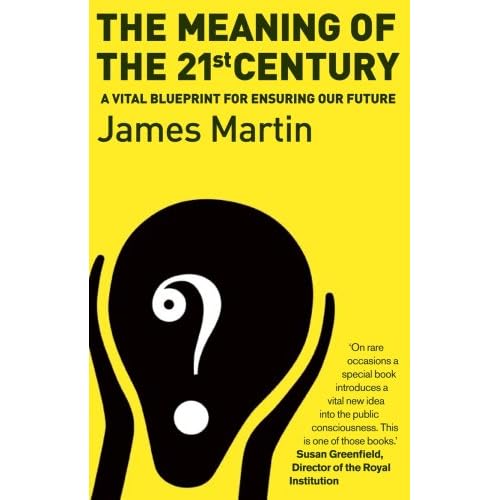
The basic thesis of this excellent book is that the 21st century will be a transformative era in human history, the book is partly in response to Lord Martin Rees' Our Final Century.
Unlike Rees, Martin is optimistic about human-beings surviving the 21st century. Martin feels that although the challenges are huge and there will be the potential for catastrophic failure (in the form of the human race ceasing to exist or civilization simply collapsing) we will still be able to tread a path to a better world.
James Martin believes that the trends in economic, demographic, technological, and social change will lead humanity into a period of history that will seem like white-water rafting after centuries of relatively smooth sailing.
Advances in areas like computing, nanotechnology, high-bandwidth communications, low-CO2 emitting power generation, genetic engineering of foodstocks and human beings, transhumanism, biotechnology, direct brain-computer links, and human augmentation will cause tremendous change and offer great promise.
But while this is happening there are also huge problems to be dealt with in the form of environmental degradation, climate change, collapsing of world fish stocks, overpopulation, nuclear war, bio-war, terrorism, failed states and poverty stricken "fourth world" countries.
After this transitional period we can build an ever more wonderful and exciting civilization.
Martin has faith in the idea of technological ingenuity and entrepreneurism solving many of the problems we are faced with.
The book reads rather like a series of slide presentations cobbled together. It's enjoyable to read and doesn't tax the mind with high-falutin' concepts (the book is apparently based on a TV series).
But I feel in his haste to make everything explicable and easy to understand Martin has left out some of the innate complexity in what he suggests.
For example his suggestions as to how to solve the problem of the development of dangerous technologies (genetically engineering viruses; cheap, portable nuclear bombs) are based around the precautionary principle, an idea I'm not entirely comfortable with.
The precautionary principle is applied when scientists are concerned that a particular line of research will lead to the creation of an immensely dangerous weapon. They will make a decision to stop pursuing that line of research.
The most obvious example is a smallpox virus, modified so as to be resistant to any vaccines that exist
The problem is that science thrives when there is a back-and-forth of knowledge and information. The precautionary principle would threaten that. If scientists decide to "hold back" in acquiring and disseminating knowledge and discoveries then the scientific community could become balkanised and fractured.
More seriously, just because one group of researchers (or their financial backers) decide to obey the precautionary principle doesn't mean there will be others who would seek their own advantage in the inaction and withdrawal of their competitors.
It is also likely that such a group will carry out their research in secret, without the overview and transparency required when dealing with potentially dangerous areas of research.
Any weapons or dangers that do emerge would then be completely hidden from everyone else, making the developments even more threatening and dangerous.
And if these weapons were used then none of the reputable and precautionary-principle obeying researchers would have the knowledge required to counteract the problem.
Although I believe advancing technology will render our current concepts of privacy irrelevant Martin is too keen to advocate extending state-control in the pursuit of terrorists.
However the vast majority of what he says makes sense. He is in favour of pebble-bed nuclear reactors, he is in favour of reducing population by educating and liberating women. He wants to extend to poor countries all the benefits and advantages of prosperous liberal democracies.
The book positively vibrates with buzz-words. One of the better ones is "eco-affluence". This is the idea that we can live happy and prosperous and enriching lives without destroying the environment. "Eco-affluence" will soon be picked up by politicians and used to describe an ideal situation for humanity.
He also discusses the idea of the singularity and non-human-like intelligence. NHL intelligence is distinct from "traditional" conceptions of AI because it concerns evolutionary programs, programs that try vast numbers of possible solutions to problems and select from those that work, learning techniques, pattern recognition and data mining.
In fact it concentrates on what computers have potential for and leaves human minds to do the stuff we have potential for, in conjunction with our computer helpers.
In conclusion, this is a must-read for everyone, particularly if you need a basic primer on where we're going as a species, the challenges we are faced with, what the opportunities are, and what human civilization will look like 92 years from now.


