
Apropos this, and this, am I the only one who perceives a parallel between burqas and sunglasses?
Probably.
Both have a "distancing" effect and both are vaguely poserish and both (arguably) have some practical purpose (I agree with Jamie Kenny that there is someting viscerally appealing about being anonymous in public).
Of course sunglasses are only considered religious wear in some Dudeic sects.
Showing posts with label religion. Show all posts
Showing posts with label religion. Show all posts
Monday, August 30, 2010


Monday, May 11, 2009
Laughter as an error-correction mechanism
Some bloke called Carlo Strenger has written a superior article on enlightenment values:
As one of the commenters points out, the profound principle that both 20th century secular ideologues and religious authorities throughout history have ignored, is that of always bearing in mind the possibility you might be dead wrong.
The healthy human response to harmless error or misunderstanding is to have a laugh. Thus error is highlighted for all to see and forgiven by all parties.
A further mistake on the part of humorless fanatics everywhere is to assume that there can ever be one, insoluble, and eternal truth. It may be that such a thing exists, but it is likely to be beyond our capacity to discern its true form from the vague shadows on the walls of our epochal cave.
And so human beings are prone to error. There's no problem with this, as failure teaches us more than success.
This idea was only properly articulated by Karl Popper in the 20th century: it is the idea you can never conclusively prove that an idea is correct, but rather disprove false ideas.
And so human knowledge grows and the enterprise of civilization advances, one laughter-inducing blooper at a time.
...the Enlightenment has created an idea of immense importance: no human belief is above criticism, and no authority is infallible; no worldview can claim ultimate validity. Hence unbridled fanaticism is the ultimate human vice, responsible for more suffering than any other.
...
it applies to the ideas of the Enlightenment, too. They should not be above criticism, either. History shows that Enlightenment values can indeed be perverted into fanatical belief systems. Just think of the Dr Strangeloves of past US administrations who were willing to wipe humanity off the face of the earth in the name of freedom, and the – less dramatic but no less dismaying – tendency of the Cheneys and Rumsfelds of the GW Bush administration to trample human rights in the name of democracy.
As one of the commenters points out, the profound principle that both 20th century secular ideologues and religious authorities throughout history have ignored, is that of always bearing in mind the possibility you might be dead wrong.
The healthy human response to harmless error or misunderstanding is to have a laugh. Thus error is highlighted for all to see and forgiven by all parties.
A further mistake on the part of humorless fanatics everywhere is to assume that there can ever be one, insoluble, and eternal truth. It may be that such a thing exists, but it is likely to be beyond our capacity to discern its true form from the vague shadows on the walls of our epochal cave.
And so human beings are prone to error. There's no problem with this, as failure teaches us more than success.
This idea was only properly articulated by Karl Popper in the 20th century: it is the idea you can never conclusively prove that an idea is correct, but rather disprove false ideas.
And so human knowledge grows and the enterprise of civilization advances, one laughter-inducing blooper at a time.
Wednesday, May 06, 2009
The Night Sessions: a few thoughts

I read this book over the weekend. A few thoughts:
1) Very good treatment of religion. Harsh criticism of faith-based brutality mediated by a genuine understanding of the nature of faith. There is a part near the end that captures the essence of what losing a strong religious faith is like perfectly:
He knew exactly what he now believed, because it was exactly what he had rejected until now. He'd stepped out of shattered armour not naked and shivering, but fully clothed. It was as if his new world-view had all along been inside the armour and being kept in, rather than outside and being kept out.
2) Very plausible treatment of sentient robots. Probably the best treatment I've seen in a while. The key point that MacLeod makes is that yer typical sentient robot is likely to have a superior theory of mind to yer typical sentient animal. Therefore robots are likely to be kinder, gentler, and more empathetic than humans.
The book is strongly recommended, being well-written, and the characters spend a lot of time talking in pubs. There is little and life that could not be improved by spending more time talking in pubs. Certainly Stephen Baxter's work would gain a lot.
[pic borrowed from here]
Tuesday, March 31, 2009
Sharpening the memetic razors
If there's one thing slightly more annoying than blog posts the existences of which are due entirely to some minor irritation on the part of their creator it is post subtitles on CiF [1] that are laid out in the manner:
The first thing that annoys me about this habit is the presumption of any journalist or blogger deciding that "we" need something. The audacity.
The second thing that annoys me about this habit is the wholly unintentional Royal Pronounity of the form. Like the author thinks they're the Queen. Damn their eyes etc.
Despite this Robert Sharp is excused, not so much because he didn't annoy me, but because he actually talks sense [2]:
More diverse memes and more aggressive selection pressure ensures that only optimal ideas are amplified and replicated.
And such is the power of liberal pluralism. If you can't stone them to death then join them.
[1] I know I promised to stop reading CiF after NNT advised that newspapers were full of tosh, but as CiF is theoretically a blog aggregate and as such a Public Forum I am entirely justified in finally dropping my ill-thought-out New Years Resolution.
[2] And in any case he is actually identifying a blogging phenomena rather than actually advocating one. I blame the copy editors for the silly (and blood-pressure-increasing) subtitle.
"We need a [insert your choice of damnfool idea here]"
The first thing that annoys me about this habit is the presumption of any journalist or blogger deciding that "we" need something. The audacity.
The second thing that annoys me about this habit is the wholly unintentional Royal Pronounity of the form. Like the author thinks they're the Queen. Damn their eyes etc.
Despite this Robert Sharp is excused, not so much because he didn't annoy me, but because he actually talks sense [2]:
Despite the robust nature of much of the debate online, I do perceive a sort of online Omerta, a Way of the Blogs. This states that if you have been offended or disrespected online, you can always fight your corner by setting up a counter-blog somewhere else. The idea is that you do not attempt to suppress the offensive material, legally or otherwise, but instead use the same medium to counter and debunk it.
More diverse memes and more aggressive selection pressure ensures that only optimal ideas are amplified and replicated.
And such is the power of liberal pluralism. If you can't stone them to death then join them.
[1] I know I promised to stop reading CiF after NNT advised that newspapers were full of tosh, but as CiF is theoretically a blog aggregate and as such a Public Forum I am entirely justified in finally dropping my ill-thought-out New Years Resolution.
[2] And in any case he is actually identifying a blogging phenomena rather than actually advocating one. I blame the copy editors for the silly (and blood-pressure-increasing) subtitle.
Tuesday, March 10, 2009
Nationalising religion
There's a brilliant post over on Overcoming Bias on the possibility that lower levels of religiosity in Europe relative to the USA is are due to the state-sanctioned nature of organised religion in much of Europe.
From an evolutionary standpoint an increase in diversity and competition caused by freedom of religion inevitably leads to selection of ever more compelling and virulent memesets (7th Day Adventists, Scientology etc). But by creating a benevolent state monopoly of the C of E the state has repressed diversity and hence the fitness of religion.
Certainly government endorsement immediately makes everything much more boring and unattractive (apparently use of cannabis actually decreased when it was relegated to a class C drug).
Hume, an agnostic if not an atheist, takes the position that religion is not a public good but its opposite — a public bad — and that government intervention will avert the pervasive negative externality of religious controversy, which clergy create and that threatens public safety.
...
The strongest argument for socialized medicine is the strongest argument for socialized religion, that government provision seems to reduce enthusiasm for and consumption of such things. Western Europe seems to have hit on the clever solution of loving both religion and medicine to death. Should we consider loving other cranks to death?
Imagine bureaus of palm reading, UFOS, conspiracy theories, etc. In a few decades they might be run by out-of-date boring bureaucrats following stacks of official protocols. If the best devotees were distracted seeking promotions in the ossified agency, they might inspire less public enthusiasm.
From an evolutionary standpoint an increase in diversity and competition caused by freedom of religion inevitably leads to selection of ever more compelling and virulent memesets (7th Day Adventists, Scientology etc). But by creating a benevolent state monopoly of the C of E the state has repressed diversity and hence the fitness of religion.
Certainly government endorsement immediately makes everything much more boring and unattractive (apparently use of cannabis actually decreased when it was relegated to a class C drug).
Saturday, September 13, 2008
An Atheist Catholic
I am an atheist Catholic. I have been confirmed but I don't believe in God.
A large part of religion for many people is the sense of community spirit and identity that comes with it.
I don't have to give up my tribe just because I don't believe in God.
A large part of religion for many people is the sense of community spirit and identity that comes with it.
I don't have to give up my tribe just because I don't believe in God.
Friday, June 20, 2008
There is No God, And Your Idiotic Human Ideals are Laughable!
A good article by Ariane Sherine over on CiF on the apparent gap between atheist expression and religious expression in the public sphere.
I personally think this is because atheists tend to be well-balanced, intelligent, and self-contained individuals that don't need to ascribe to a tribalistic ideology to support their egos.
However I would certainly not describe myself as well-balanced, intelligent, or self-contained. As such:
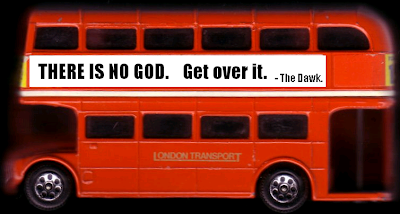
[original image by SideLong on flickr]
I personally think this is because atheists tend to be well-balanced, intelligent, and self-contained individuals that don't need to ascribe to a tribalistic ideology to support their egos.
However I would certainly not describe myself as well-balanced, intelligent, or self-contained. As such:

We're not asking you to believe, it's true anyway
[original image by SideLong on flickr]
Wednesday, May 21, 2008
One Last Post...
One of the more annoying aspects of the NewsCloud is it's tendency to simplify then exaggerate.
Take science vs. religion.
The mere fact that you have some idea of what I'm talking about it disgusting. How can such a puerile expression be useful? As a mental hook for something so complex and profound (and so misunderstood) that it escapes almost all serious consideration.
In the last 24 hours the British parliament has been debating and voting on a series of issues associated with abortion (should the last date at which an abortion can happen be lowered from 24 weeks), hybrid embryo research, and saviour siblings.

Some tasteful sketches of a foetus from Leonardo da Vinci
All these are important issues. I won't comment on them because there are facets of the debate (particularly associated with abortion), which I simple don't know about.
These issues are important and as such they should be treated as such. This is not, nor has it ever been, about "science vs. religion."
That expression "S vs. R" begs so many questions it is almost impossible to dissect it without falling into the trap of dignifying the debate, but I will attempt it.
Science is a tool. It is a way of thinking about, and observing the world. Empirical evidence (input from our sensory apparatus, both biological and artificial) and recorded data acquired through empirical means are considered.
Once they have been considered scientists think of ways that any patterns, or lack of pattern, in the data can be explained. They create a hypothesis.
They then attempt to disprove the hypothesis. They create experiments that are intended to disprove their hypothesis. If a hypothesis stands up to this treatment, and the work of one scientist is corroborated by the work of many other scientists, then an hypothesis is accepted as a scientific theory.
Yes, I know there's more to it than that. Check out this document on the scientific method for more details on the subject.
Religion is many things to many people. To me it is yet another system of control, external to myself.
It is also a panacea in moments of weakness. It is a crutch and it is community. Sometimes it is good and sometimes it is bad. Sometimes it is right. Usually it is wrong.
I do not judge those who have faith. I know what faith is. It is like a powerful drug, and it can make difficult things ... less difficult. I have had faith.

However I am entirely within my rights to call anyone who believes in the afterlife a fool and anyone who thinks the universe is run by some dude with a beard who isn't a science fiction writer of some sort (if God can't be a science fiction writer, or is not a full-time [and published] science fiction writer I quit - god is wrong and it is immoral to have faith ;-)) an idiot.
Anyway I despise how this argument is corrupted and dragged through the dirt by slavering hacks wanting to churn out copy on a "controversial" debate.
Addendum: I am entirely aware that this article is without evidence, empirical or otherwise. It is also fairly badly written. So sue me.
Take science vs. religion.
The mere fact that you have some idea of what I'm talking about it disgusting. How can such a puerile expression be useful? As a mental hook for something so complex and profound (and so misunderstood) that it escapes almost all serious consideration.
In the last 24 hours the British parliament has been debating and voting on a series of issues associated with abortion (should the last date at which an abortion can happen be lowered from 24 weeks), hybrid embryo research, and saviour siblings.
Some tasteful sketches of a foetus from Leonardo da Vinci
All these are important issues. I won't comment on them because there are facets of the debate (particularly associated with abortion), which I simple don't know about.
These issues are important and as such they should be treated as such. This is not, nor has it ever been, about "science vs. religion."
That expression "S vs. R" begs so many questions it is almost impossible to dissect it without falling into the trap of dignifying the debate, but I will attempt it.
Science is a tool. It is a way of thinking about, and observing the world. Empirical evidence (input from our sensory apparatus, both biological and artificial) and recorded data acquired through empirical means are considered.
Once they have been considered scientists think of ways that any patterns, or lack of pattern, in the data can be explained. They create a hypothesis.
They then attempt to disprove the hypothesis. They create experiments that are intended to disprove their hypothesis. If a hypothesis stands up to this treatment, and the work of one scientist is corroborated by the work of many other scientists, then an hypothesis is accepted as a scientific theory.
Yes, I know there's more to it than that. Check out this document on the scientific method for more details on the subject.
Religion is many things to many people. To me it is yet another system of control, external to myself.
It is also a panacea in moments of weakness. It is a crutch and it is community. Sometimes it is good and sometimes it is bad. Sometimes it is right. Usually it is wrong.
I do not judge those who have faith. I know what faith is. It is like a powerful drug, and it can make difficult things ... less difficult. I have had faith.
It's glowing! It must be SCIENCE!
However I am entirely within my rights to call anyone who believes in the afterlife a fool and anyone who thinks the universe is run by some dude with a beard who isn't a science fiction writer of some sort (if God can't be a science fiction writer, or is not a full-time [and published] science fiction writer I quit - god is wrong and it is immoral to have faith ;-)) an idiot.
Anyway I despise how this argument is corrupted and dragged through the dirt by slavering hacks wanting to churn out copy on a "controversial" debate.
Addendum: I am entirely aware that this article is without evidence, empirical or otherwise. It is also fairly badly written. So sue me.
Friday, February 01, 2008
Freeconomy
This is brilliant.
From the BBC website:
"A man has started a two-and-a-half year walk from Bristol to India without any money - to show his faith in humanity.
These are brilliant books, but the fact that someone is willing to experiment with a real Manfred Macx lifestyle is excellent.
Later:
After having thought about this for a while I realise why I am a filthy capitalist and why what Mark Boyle is doing is admirable but ultimately less-than-optimal.
Human beings will always trade and exchange goods and services. All money does is create a communal illusion of the value of a piece of paper or plastic that allows transfer of goods and services to be more efficient.
As a reformed Catholic I am also tempted to point out that freeconomy falls foul of the general question: "what if everyone behaved like this?"
In other words, if everyone decided to up sticks and travel across Eurasia with nothing but a pair of sandals and a can full of B.O. then pretty soon civilization would collapse and millions would starve as a result.
This is why anarcho-communism/syndicalism/socialism doesn't stand a chance. As a very general rule co-operation tends to be of a self-interested nature.
The ethic of reciprocity works. There may be an evolutionary basis for morality. This is heavy stuff.
Anyway good luck to Mr Boyle. I imagine he will be treated as a sort of mendicant monk.
From the BBC website:
"A man has started a two-and-a-half year walk from Bristol to India without any money - to show his faith in humanity.
Equipped with only a few T-shirts, a bandage and spare sandals, former dotcom businessman Mark Boyle is set to cross Europe and the Middle East."
The ideas of the "freeconomy" sounds a lot like anarcho-socialism promulgated in Ken MacLeod's The Cassini Division and Charles Stross' Accelerando (also available as a download here).These are brilliant books, but the fact that someone is willing to experiment with a real Manfred Macx lifestyle is excellent.
Later:
After having thought about this for a while I realise why I am a filthy capitalist and why what Mark Boyle is doing is admirable but ultimately less-than-optimal.
Human beings will always trade and exchange goods and services. All money does is create a communal illusion of the value of a piece of paper or plastic that allows transfer of goods and services to be more efficient.
As a reformed Catholic I am also tempted to point out that freeconomy falls foul of the general question: "what if everyone behaved like this?"
In other words, if everyone decided to up sticks and travel across Eurasia with nothing but a pair of sandals and a can full of B.O. then pretty soon civilization would collapse and millions would starve as a result.
This is why anarcho-communism/syndicalism/socialism doesn't stand a chance. As a very general rule co-operation tends to be of a self-interested nature.
The ethic of reciprocity works. There may be an evolutionary basis for morality. This is heavy stuff.
Anyway good luck to Mr Boyle. I imagine he will be treated as a sort of mendicant monk.
Monday, January 07, 2008
Coming Up...
Questions: "Are some cultures inherently superior to others?" "Is there a God and should I give a crap?" "What mobile phone will I buy?" "Will anyone read this blog?" "Will I pass my January exams?" "Why can't I get a girlfriend?" "Who will win the presidency of the USofA?" and "Are all these questions connected?"
Lists: "My to-read list for 2008." "Books I have read."
Analysis: "Discussions surrounding the World Question Centre [What have I changed my mind about?]."
Lists: "My to-read list for 2008." "Books I have read."
Analysis: "Discussions surrounding the World Question Centre [What have I changed my mind about?]."
Subscribe to:
Posts (Atom)


